
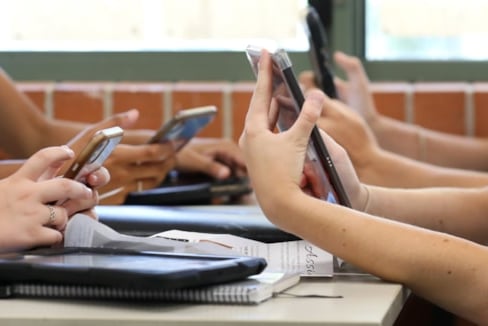
A proposal to introduce a legally binding, nationwide ban on mobile phones in Welsh classrooms has been rejected by the Senedd.
Members voted 50 to 38 against a Reform UK motion on 4 November following a debate in the Siambr.
The Senedd instead approved a Plaid Cymru amendment supporting “clear national expectations” on phone use while allowing individual schools to adapt policies that reflect their own circumstances.
The Welsh Government is currently running a 12-week consultation on statutory guidance designed to restrict phone use during the school day.
Leading the debate, Reform UK’s leader in Wales Helen Jenner MS, argued that headteachers and governing bodies require “clear legislative direction” rather than voluntary flexibility.
She criticised the Welsh Government’s proposed guidance as “wishy-washy”, calling for statutory restrictions across all classrooms except where devices are medically or educationally necessary.
Reform’s shadow education minister Stephen Senior said: “Governing bodies, headteachers and teachers want clear direction on this matter - very clear direction.
“They don't want discretion; they want it to be set out in legislation.
“They want more than statutory guidance based on laws that predate the widespread use of mobile phones.”
Accepting there may be circumstances where phones were necessary, Conservative MS Sam Rowlands also supported a full statutory ban, telling members that 114 education systems worldwide have introduced them.




The Conservative's education spokesperson said: "An all-Wales policy means that every teacher, every parent and every learner will know exactly where they stand, eliminating the confusion that separate policies from school to school and area to area bring.
“A single policy will mean that everyone feels supported by the Welsh Government in enforcing the ban and expectations will be clear across all of Wales.”
However, support for the Reform motion was rejected by Labour and Plaid Cymru, arguing that schools need autonomy to manage their pupils.
Labour's Lynne Neagle, education secretary in the previous administration, spoke of the importance of finding a balance between local flexibility and national guidance.
Plaid Cymru’s Sarah Rees warned that banning mobile phones failed to address broader issues created by smartwatches and other wearable technology.
She said: “Those challenges won't disappear if smartphones are banned from the classroom. That's why we need to do more than set rules about devices.
“We need to equip young people with the skills to navigate technology safely, responsibly and respectfully.”
She also said that any approach had to recognise the differing needs of learners and "realities faced by schools and colleges".
She said: “Those challenges won't disappear if smartphones are banned from the classroom. That's why we need to do more than set rules about devices.
“We need to equip young people with the skills to navigate technology safely, responsibly and respectfully.”
Education minister Anna Brychan told MSs the debate was not solely about mobile phones, but about creating conditions where young people can “learn, participate, build positive relationships and achieve their full potential”.
She clarified the final guidance will be subject to evaluation and said if guidance was not delivering expected outcomes, further action would be considered - including legislation.
Comments
We've recently changed our login process. If you have an account for commenting, you will need to re-register on the login window.
This article has no comments yet. Be the first to leave a comment.