

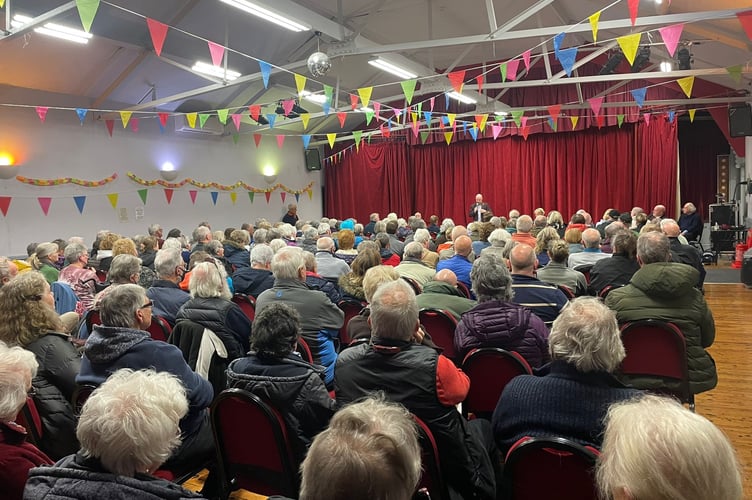
People living in Tywyn and Dyffryn Dysynni have backed calls for more GPs and dentists to help meet ever-increasing pressures on local health services in south Meirionnydd.
At a packed public meeting at Neuadd Pendre in Tywyn last Thursday, nearly 200 people turned up to have their say on health services in the area.
Amongst the issues raised was the desperate need for more GPs and dentists, a call for the health board to make better use of Tywyn Hospital by increasing bed capacity and recruiting more nurses to help alleviate the crisis in primary care.
Concerns were also raised by those living on the periphery of the Betsi Cadwaladr University Health Board area, who felt that their health needs were being overlooked given their proximity to three different health boards, the others being Hywel Dda and Powys.

Mabon ap Gwynfor MS, who organised the meeting, said: “Tywyn and Bro Dysynni has seen a rapid decline in the provision of health services in a short period of time. It is an issue of widespread concern within the local community, one that people want to see addressed as a matter of urgency.
"From a lack of GPs, the scant availability of dentists, to an under-resourced and under-used community hospital - people living in Bro Dysynni are at the thin end of the wedge when it comes to accessing primary care services close to home.
"People are understandably worried, for themselves and their loved ones. This was reflected at a packed public meeting in Tywyn, which I had organised to gauge exactly how this deterioration in health services is impacting on people’s lives.
"Whilst the situation in Bro Dysynni is by no means unique, the problem is that much more acute here, and will be repeated across rural Wales in the coming years unless we address these specific socio-health challenges in the here and now.
“Whilst barriers to healthcare in Bro Dysynni are extensive, problems facing General Practice are acute, worsened by a combination of factors, including rurality, an aging population, fallout from Covid, and retention and recruitment issues.
“To compound the situation, we’re now seeing more GPs retiring early because of burn out. I recall repeatedly forewarning the government years ago that we faced an impending crisis in General Practice with mass early retirements - but nothing was done.
“In Tywyn, we lost two very good GPs a few years back, and the partnership couldn’t attract enough new partners. The GPs that remain are brilliant. I have complete confidence in them, and they go over and above what is required.
“But we need to recruit new GPs and retain the ones we have and stop the flow of GPs leaving for greener pastures. It’s a big ask. But the health board needs to look at their human resources strategy when it comes to recruiting new GPs.
“One way is to give GPs contracts. It may seem a simple enough suggestion, but I learnt recently that locums to a managed practice – a practice run by the health board don’t receive a contract – they essentially work a zero-hour contract and are paid on trust. This must change.
“Control of a GP practice needs to come back to the practice, not controlled by faceless managers in Bangor or Bodelwyddan. This would ensure local answerability so that management see the impacts on the ground.
“More than half of the Welsh Government’s budget is spent on the health service. But of this, only 8 per cent is allocated to GPs. Yet GP practices carry out more than 80 per cent of the work and it is where most of us start and end our treatments.
“There are no short-term answers to resolving the crisis in primary care. There is no magic pill. Frontline staff on the ground in Bro Dysynni are working hard to make the best use of the resources available to them.
“We’ve seen small steps in the right direction including the recruitment of a care coordinator and investment in upskilling an advanced nurse practitioner. But they need more, and to meet that demand the Health Board must listen to people’s concerns and treat this situation with the seriousness it deserves. We desperately need to see the board employ new GPs in Tywyn.”
Karen Higgins, director of primary care at Betsi Cadwaladr University Health Board, said: “A decline in GP numbers across the UK has been seen in recent years, leading to some well documented challenges in accessing appointments even as demand is growing.
“We are exploring all opportunities to attract new GPs to the Tywyn area, including the use of recruitment agencies, and linking in closely with medical schools across Wales and the UK to attract GP registrars.
“We recognise there is a national shortage of care workers across both Health and Social care providers but it’s particularly challenging in north Wales, and despite the Health Board and our partners doing everything we can to recruit, we need more people in these positions and quickly.
“A hospital is not the right environment for patients who are deemed medically fit for discharge. We know that the longer a patient stays in hospital, the more their physical and mental health can deteriorate, as well as their risk of hospital-acquired infection.
“Even if creating additional capacity in community hospitals was an appropriate response to this issue, this would not be possible due to the significant nursing staffing challenges we continue to face.
“Recruitment to registered nurses’ posts remains a challenge across the UK. There is significant recruitment activity taking place for roles across north Wales and we have seen an uptake in the number of healthcare assistants taking on university courses to develop into qualified nurses.
“We are also pleased to be re-establishing the Nursing Cadet Course within our health board which will provide opportunities for school leavers to join the nursing sector.
“Healthcare and nursing is a really rewarding vocation and I would urge anyone who wants to start their career with us to visit our website for further details.”
Comments
This article has no comments yet. Be the first to leave a comment.