

Like most people, I am familiar with the concept of fostering, but I had never heard of parent and child fostering before, until a press release from Foster Wales arrived in my inbox.
Foster Wales is the national network of not-for-profit local authority fostering services in Wales. Its main aim is to provide children with the opportunity to stay local, thrive and improve their life chances through well supported foster carers.
In certain circumstances both the child and the child’s parent are looked after by a foster family, but there is a severe shortage of people to fulfil this need.
According to the press release I received, “138 parent and child placements were needed in 2024-2025, but only 13 local authority parent and child foster carers exist across Wales. This means that most parents and babies are moved far from home into residential settings, often outside Wales.”

So, what’s the solution?
Foster Wales say it is “keeping families together through parent and child foster care”.
“Local authority foster care allows 83 per cent of children to stay local, compared with just 26 per cent through independent agencies.
“This means that parents learn skills in a real home in their local area, not a clinical setting or somewhere far removed.”
Now Foster Wales is calling on people who can offer patience, stability and the ability to support parents without judgement.
“Parent and child foster carers urgently needed in Wales,” they explained, “to help young parents develop their parenting skills and keep families together.
“Parent and child fostering involves a foster carer welcoming a baby or young child alongside their parent into their home and nurturing their growing relationship, ultimately giving them the tools to live independently. The need for this type of fostering is on the rise, but there is a significant shortage of foster carers available to accommodate demand.
“Between April 2024 and March 2025, 138 parents with their children needed to be brought into care together in Wales.
“Only 20 of these were able to stay with local authority parent and child foster carers.
“Another 29 were cared for by foster carers with independent fostering agencies, often far from their local community.
“The remaining 74 were placed in residential care, rather than a family home environment.
“Foster Wales is calling for more people who can offer this type of foster care to help increase the availability of parent and child foster care in Wales.”
The ‘Cambrian News’ wanted to hear from parent and child foster carers from Ceredigion or Gwynedd, but it seems there aren’t any at the moment.
Foster Wales said: “At the moment, there don’t appear to be any PAC carers in Gwynedd.
“Ceredigion have advised that they haven’t had any in-house PAC carers for several years. However, they have indicated that there is a recognised need for them.”
So, to hear more about what it is like to be a parent and child foster carer, we cast our net further afield.
Lorraine and Paul from Neath Port Talbot, who have been foster carers for 13 years, were happy to share their experience.
In that time, they’ve had 20 parents stay at their home with their children. They also have eight adult children of their own.
Paul said they have supported parents in many different circumstances, but the most frequent requiring care are young mums with babies.
“If mum was to come to us four to six weeks prior to birth, then we can do a lot of the work to build a relationship and trust,” Paul said.
“Then when the baby is born, we can hit the ground running. We’ve got mum’s trust and she understands the process clearly. We're going to work with them to create an environment where they can do good enough parenting.”
Paul said they receive constant support from a social worker, as well as any other services a parent might need while in their care. Being parent and child foster carers has also given their children a broader view of the world.
“Our children have grown up in a safe, loving, caring, happy environment,” Paul said.
“So to be among children who have not had that kind of life has given them a much greater balanced view on life and a better understanding of other people.”
Deanna and Rob Roberts are both PAC (Parent and Child) foster carers and are based in Anglesey.
Deana and Rob’s first experience of fostering came when Rob was in the RAF, stationed in Germany. The couple provided care for children impacted by the Chernobyl disaster to allow them a break from living near the radiation contamination.
When they moved back to Anglesey they decided to foster, finding they had a particular aptitude for parent and child fostering. Deana said she sometimes finds it easier to provide care for an older person, supporting their relationship with their own child.
“Every time you have a baby, you have to do everything for it as if you’re a parent,” Deana said. “When that child moves on to adoption, it rips your heart out. It literally does. That’s why I prefer the parent and child to that because you don’t get that intense bond with the child because you’re there promoting the bond with the parent.”
Caroline De Havilland, who lives in Goodwick in Pembrokeshire, became a parent and child foster carer later in life.
Now, 75, Caroline retired at 68 and “enjoyed the novelty of that at first”.
“I thought great, I don’t have to do anything or get up for anything, but that soon wore off and I realised I wanted to do something.
“My friend Rachel, who I’ve known since our children were small, is a parent and child foster carer in Pembrokeshire.
“I admired her and her husband and everything they’ve done over the years to help children and their parents through fostering, and I thought I’d love to be able to help mothers and their children like that too.
“I had to go on courses for safeguarding and things, which are updated every so often, and we get lots of support. We have a link worker who is brilliant and I can phone her any time.
“Parent and child foster caring is so important because it helps children stay with the parent, so if I can do something to help a mother keep her baby, then I am happy to do so. That’s one more child that is going to stay with their mother and won’t suffer from trauma, attachment disorders and behavioural problems some adopted children have. I can’t imagine being a child and being taken from one person to another.
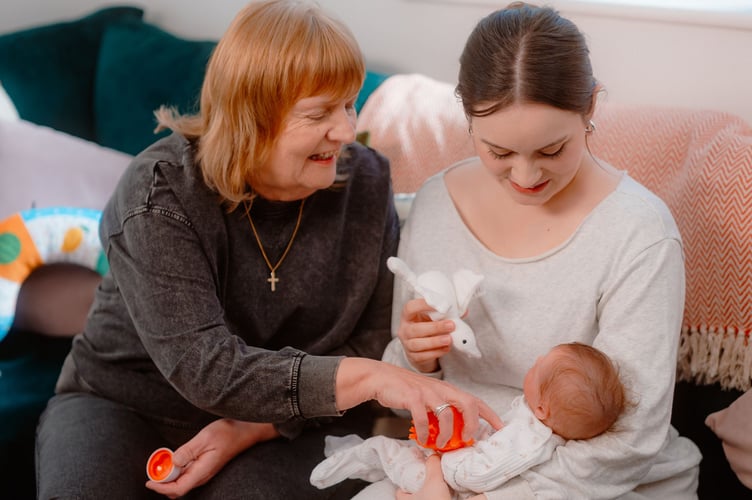
“Some of the mums have problems too, perhaps from drugs in the past, and hopefully this service helps them as well. It’s important not to judge these mothers, and to have empathy for them. We don’t know what these women have been through.”
Caroline’s first relationship with a mother and baby broke down after three weeks, but the next one lasted about 20 weeks.
“You’re told the average amount of time they will stay will you is 12 weeks, but in reality it can be longer, sometimes six months, and sometimes longer than that.
“But it is better for these parents and their children to be in a house rather than a mother and baby home because it’s more homely.”
After spending some time being a full parent and child foster carer, Caroline now offers respite to her friend Rachel.
“When she needs a break or a week away, I cover her and the mother and child she is looking after will come to me,” Caroline explained.
“I just wish we could get more people to do this. There’s only Rachel and I in Pembrokeshire.
“It can be emotional if a baby does get taken from its mother, so you have to be strong, but it’s such a lovely feeling when it works and you see a mother and child stay together.
“To know that child won’t be adopted, will be raised with their own family, and avoid trauma in the future, is great.
“And it would be great to have more PAC carers in every county so people can stay in their home area.
“They have enough to deal with, and the fact they are willing to stay with someone shows they want to succeed, so it would be great if there were more PAC carers in every county to help.
“I may be 75 but I want to carry on. If I can prevent one child being taken away from her mother then I am happy.”
Alastair Cope, Head of Foster Wales, said: “Parent and child foster care provides those who are often young and vulnerable themselves the opportunity to become confident, capable independent parents in a comfortable, loving home environment.
“With those strong foundations in place we can prevent many cases of families breaking down in the first place, avoiding children being separated from their parents which can have a lifelong impact.
“We’re urging people who feel they could offer a safe, supportive home to come forward – with the right care and guidance, foster carers can make a life-changing difference by helping parents build the confidence and skills they need to care for their children independently.”
He added: “We are calling on individuals and families across Ceredigion, Gwynedd, Powys, Pembrokeshire and Carmarthenshire who feel they could provide a supportive home to come forward. With the right training, professional guidance and dedicated support, Parent and Child foster carers can make a life-changing difference, empowering parents, and keeping them with their children to give them the best possible start in life.
“By offering a safe and nurturing home environment, foster carers give parents, many of whom are young and facing significant challenges, the chance to develop the confidence, skills and resilience they need to care for their children independently. It's an incredibly rewarding experience to offer children the opportunity to stay together with their mum or dad. Increasing the amount of families offering parent and child fostering in these local areas is essential for ensuring families can stay together wherever it is safe to do so.”
One area of fostering that has seen a rise across Wales, and in Ceredigion, is in the LGBTQ+ community.
LGBTQ+ foster carers are making up a greater proportion of the total number of carers in Wales, according to new figures.
There are 56 LGBTQ+ households in Wales, an increase of 30 per cent compared with 2024. In Ceredigion, LGBTQ+ foster carers looked after seven children in 2025.
Although there has been a rise in this area of fostering, there is a need for more carers. During LGBTQ+ Adoption and Fostering Week, which ran from Monday, 2 until Friday 6 March, Foster Wales Ceredigion urged LGBTQ+ people to consider making enquiries to become foster carers and change lives in 2026.
Foster Wales said: “Couples or single people can foster, and many LGBTQ+ people have unique personal life experience to bring to the care of children and young people.”
Cllr Alun Williams, Deputy Leader of the Council and Cabinet Member for Through Age Wellbeing, said: “It is really encouraging to see such a significant rise in the number of LGBTQ+ fostering households in Wales. Here in Ceredigion, we are proud of our LGBTQ+ foster carers who provide loving, understanding and secure homes for our children and young people. Their lived experience, resilience and compassion make a real and lasting difference every single day."
Suzanne Griffiths, Director of the National Adoption Service for Wales and Foster Wales, added: “Foster carers make an extraordinary difference to children and young people every day by offering stability, understanding and a safe place to thrive. They draw on their own life experiences, compassion and resilience to meet the individual needs of each child. For some children, foster carers can help them move on to adoption, which will provide the lifelong security they need when returning to their birth family is not possible.
With so many children currently in need of loving homes, we would strongly encourage anyone considering fostering or adoption to come forward and start a conversation with their local team today.”
For more information on fostering visit https://fosterwales.gov.wales.
Comments
This article has no comments yet. Be the first to leave a comment.