
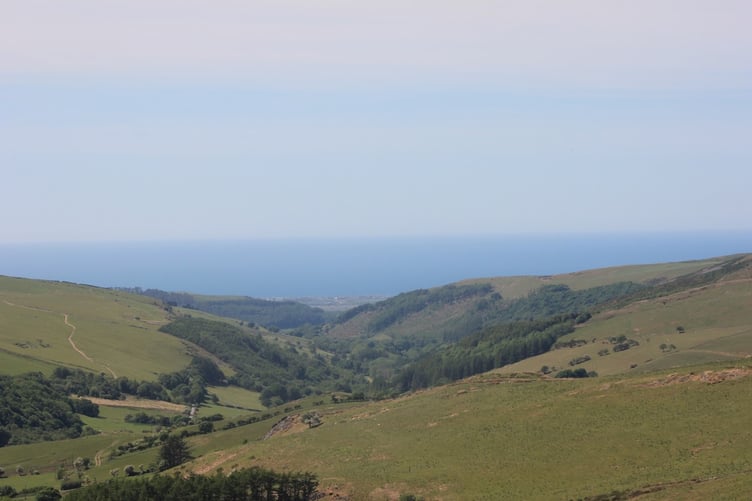
From a distance, the Cambrian Mountains can look like mile upon beautiful mile of windswept nothingness. Beneath the grass and bog, however, lies a landscape thousands of years in the making.
Blanket bog stores carbon, slows rainwater and supports upland wildlife. In nearby valleys, toxic metals from long-abandoned mines remain buried in riverbeds and farmland, ready to be disturbed by floods.
Now, as developers consider dozens of giant turbines across Ceredigion, Carmarthenshire and Powys, a pressing question is being asked: how much of this landscape can be altered in the name of protecting the environment?
It is a question with an uncomfortable answer in the Welsh Government's own files.
An internal briefing dated January 2025, subsequently released under information legislation, estimated that around 22 wind farms had already been built on peat in Wales and that 35 of 45 schemes then in the planning pipeline could affect peatland.
Officials calculated that, if those proposed developments proceeded as assessed, emissions associated with disturbing peat could cancel out the equivalent of 11 to 16 years of emissions savings achieved through Wales's National Peatland Action Programme.
These were projections, not damage already measured, and did not imply that wind farms would lose all their own carbon benefits. But the warning exposes a tension: land relied upon to tackle climate change may be threatened by infrastructure designed to do the same.
Officials argued that better site selection could allow wind generation without significant peat impacts.
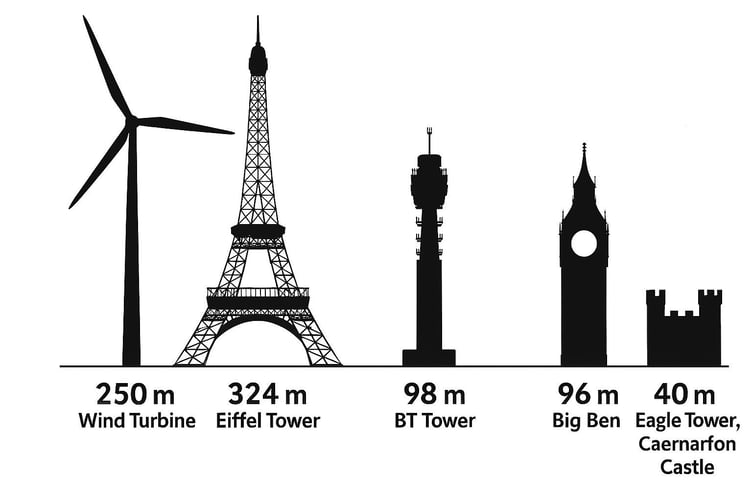
The scale of what is proposed makes that distinction important. Bute Energy's merged Lan Fawr scheme, straddling the Ceredigion-Carmarthenshire boundary south-east of Tregaron, proposes up to 55 turbines reaching 220 metres, with a combined capacity of about 368 megawatts.
Its Waun Hesgog proposals north-east of Aberystwyth envisage up to 37 turbines, while EDF's emerging Nant y Maen project east of Tregaron proposes up to 27. These projects are at different stages; none of those turbine totals should be mistaken for a final consent.
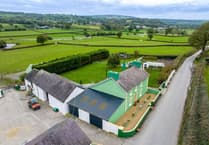



The turbines themselves are only the most conspicuous part of the operation. Behind them comes a considerable supporting cast of concrete foundations, access roads, substations and electricity pylons.
Peatlands cover just 3 to 4 percent of Wales's land yet contain around 30 percent of its soil carbon, according to Welsh Government guidance. When drained or excavated, peat can lose carbon accumulated over centuries. Its hydrology, and the habitats depending upon it, can also be difficult to restore.
At a meeting at Theatr Arad Goch in Aberystwyth on 7 November, organised by Greener Aberystwyth Group, Doug Lloyd questioned whether peat mapping captures the depth and complexity of some upland sites.
His concerns underline the importance of site surveys, although claims about unusual peat depths require location-specific measurements.
The Welsh Government's March monitoring report offers another revealing statistic. Of 37 wind development cases across approvals, applications and early scoping, 17 were outside its pre-assessed areas for large-scale wind power. Officials questioned why more promoters were not choosing land already identified as more suitable.
Those boundaries are not absolute prohibitions. The disagreement is also about where turbines should go.
For one proposed development, the environmental case looks rather different when read from the applicant's side. The assessment for Lluest y Gwynt, near Ponterwyd, describes 12 turbines up to 180 metres high and acknowledges peat within the site. It concludes that mitigation would leave minor or negligible residual effects on peat and soils, and estimates a central carbon-payback period of roughly 1.1 years, although the model's range is considerably wider.
This is the applicant's assessment, not an independent finding. Potential environmental harm is not identical to inevitable damage.

A landscape already carrying an industrial legacy
Another warning comes from Professor Mark Macklin, a river scientist whose research has traced the effects of historic metal mining through the waterways of west Wales.
At the meeting, chaired by Aberystwyth University professor Rhys Jones, he explained that mine contamination can travel far from its original source.
Natural Resources Wales says around 1,300 abandoned metal mines exist across Wales, with more than 500 tonnes of metals entering rivers annually. It attributes the failure of nearly 700 kilometres of rivers to meet water-quality standards to pollution from abandoned mines.
In parliamentary evidence this June, Professor Macklin offered a broader research estimate: 1,677 kilometres of Welsh rivers affected by lead, around 140 square kilometres of contaminated floodplain, and approximately 6,750 people living on such land. His river figure measures something different from NRW's.
His research into the devastating June 2012 floods in west Wales found metal-rich sediments deposited on farmland, in some instances at concentrations many times recommended thresholds. Contamination in silage was associated with cattle poisoning and deaths.
There is no established evidence that the wind farms currently proposed in Ceredigion would cause this pollution, or that their construction would necessarily release it. The old mine workings predate the projects by generations.
The science shows why soil, drainage, sediment and mine records must be investigated before major groundworks in sensitive catchments. A wind farm is more than a cluster of turbines.
Who pays, and who benefits?
The geography is only half the controversy. The other half is money.
At the meeting, Lorna Brazell questioned whether generation was being planned where the electricity network could efficiently serve customers, and challenged the assumption that cheap wind generation meant cheap household bills.
She also asked where the profits would eventually go. Statkraft, a partner in the Lluest y Gwynt project, is owned by the Norwegian state; EDF, behind Nant y Maen, is owned by the French state.
Such investment can bring local work and tax revenues, but foreign ownership is not the same as community ownership. It raises the question of how much long-term value would remain with the places hosting the turbines.
Gas-fired generation frequently sets Britain's wholesale electricity price when it is the most expensive power needed. Household bills also include network and balancing charges, even when the wind itself is cheap to harness.
Those costs are not theoretical. In figures released this month, the National Energy System Operator put Great Britain's electricity system-balancing bill for 2025/26 at £3.1 billion, up 16 percent on the previous year and equivalent to 4.3 percent of a typical household electricity bill.
Just under £500 million went to wind generators to reduce output when the grid could not accommodate it. The £3.1 billion covers the whole system, not idle turbines alone. The operator stresses that much of the replacement gas would still have been needed without wind power.
Unfortunately, electricity cannot simply teleport from a Welsh hillside to wherever it is needed. Getting it there requires cables, substations, pylons and, almost inevitably, an almighty argument.
Under the Government's Contracts for Difference scheme, generators receive support when the reference market price falls below an agreed level and pay back the difference when it rises above it.
The latest auction puts the onshore wind strike price at £72.24 per megawatt-hour in 2024 prices. New contracts can stabilise revenue for 20 years, without guaranteeing profits. The strike price is not a household tariff.
Then comes the rather eye-watering sum of up to £800 million. That is the potential lifetime community benefit Bute Energy advertises across its proposed Welsh portfolio. The two most important words, however, are “up to”.
But these figures are conditional on approval and operation, not money already distributed. Critics question who controls the funds, how communities choose priorities and whether grants compensate for landscape changes.
Bute says its proposals could generate significant clean electricity and local investment, while its planned projects remain subject to public consultation, environmental assessment and decisions by Welsh Ministers.
The rows spreading across west Wales
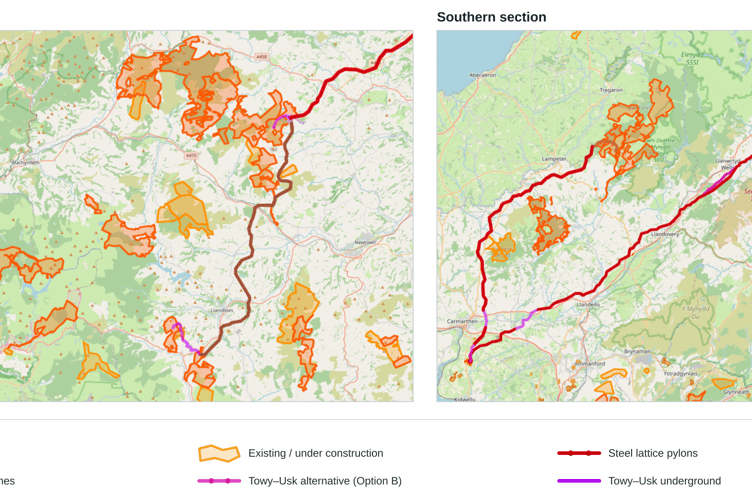
In the Tywi Valley, the argument has acquired an entirely new dimension. The turbines are contentious enough, but the pylons required to connect them have proved another formidable headache. Campaigners fear that routes associated with new wind farms and energy parks would reshape views, farms and villages across Carmarthenshire.
At a meeting in Llandeilo on 31 October, Our Tywi Valley called for the area to be designated a National Landscape, formerly known as an Area of Outstanding Natural Beauty. Its chair, Daljit Singh, said residents wanted protection from the cumulative spread of turbines, substations and overhead lines.
Vice-chair Havard Hughes argued: "Our historic landscape should not be destroyed so that the Welsh Government can tick a climate target box."
The organisation highlighted the corridor towards Llandyfaelog. Network promoters say new lines are needed to connect generation; routes and footprints remain subject to consultation and planning.
In October, the Welsh Government opened a consultation on an undergrounding-first policy for new 11–132kV electricity lines, acknowledging the sensitivity of overhead infrastructure. It is a proposed policy, not a blanket requirement already in force.
Local authorities have also been drawn into the dispute. In January, Ceredigion County Council passed a motion supporting renewable energy in principle but seeking stronger landscape safeguards, attention to cumulative effects, better grid planning and a greater local stake in the benefits.
At Aberystwyth, attendees criticised what they saw as insufficient political action. Reform UK MS Claire Archibald attended, however, despite complaints about engagement from elected representatives.
In Carmarthenshire, councillors have likewise pressed the Welsh Government over the pace and scale of large developments. Councillor Arwel Davies described the approach as resembling a gold rush for developers, while councillor Handel Davies warned of the visual effects of turbines and pylons.
The debate also exposed a split over whether tougher restrictions would unfairly affect farmers hoping to diversify their income through renewables.
The Welsh Government considers clean generation central to climate targets and energy security. It aims for annual renewable output equivalent to 100 percent of Welsh electricity consumption by 2035, not renewable supply every hour.
A different picture on the Pembrokeshire coast
Across the border in Pembrokeshire, the prospect of wind power produces a different mixture of anxiety and opportunity.
Around 35 kilometres offshore, the fully consented Erebus floating wind demonstration scheme, developed by Blue Gem Wind, is planned at 100 megawatts.
The company estimates it could generate an annual quantity of electricity equivalent to the needs of up to 93,000 homes, avoiding around 150,000 tonnes of carbon emissions each year. Construction is envisaged before the end of the decade.
Another Celtic Sea project, Llŷr, forecasts around 2,000 jobs during construction. Those are developers' projections, not permanent posts already created in Pembrokeshire. Whether local firms, ports and workers capture a substantial share of the investment is therefore crucial.
Following a Westminster debate in December 2024, local MP Henry Tufnell argued that the transition should put Pembrokeshire's workforce first. For a county with industrial skills and coastal infrastructure, offshore wind offers the prospect of a new economic role without placing every turbine on its hillsides.
Offshore projects still require ports, cables and onshore infrastructure. Near Sageston, an application to replace a 60.5-metre turbine at Summerton Farm with a 76-metre machine was delayed earlier this year pending further bat surveys. A previous 90-metre proposal was refused on visual grounds.
The debate also has a local ownership alternative. At Cwmgors, just beyond Carmarthenshire, community-energy organisation Awel Aman Tawe helped establish two turbines on Mynydd y Gwrhyd.
Revenue from the community-owned wind project contributed to the purchase of the former village primary school, subsequently transformed into Hwb y Gors, a low-carbon community hub.
It illustrates the difference between receiving grants from a developer and taking ownership of energy generation. Both offer benefits; they are different models.
The price of progress
Wales needs to cut emissions. Renewables accounted for 37 percent of electricity generated in Wales in 2024, equivalent to roughly 55 percent of Welsh electricity consumption, government statistics show. The measures use different denominators.
The question is no longer simply whether wind power is good or bad. It is whether a project designed to save the planet should be allowed to leave parts of it substantially worse off, and whether the people living alongside it will receive a fair share of the rewards.
The government's own peatland warning makes that a question which cannot be brushed aside as opposition to a greener future.
Comments
We've recently changed our login process. If you have an account for commenting, you will need to re-register on the login window.
This article has no comments yet. Be the first to leave a comment.