
Thousands of people signed a petition within the first few hours of its launch calling for urgent aerial support for the Rhinogydd wildfire on its eleventh day.
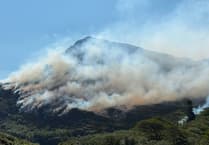
The Rhinogydd fire near Cwm Bychan Lake was first reported on 12 July but has received no aerial support from helicopters despite the fire's unreachable highland conditions.
Over 4,000 people have since signed a petition started by a resident on 21 July urging authorities to do what's needed to stop the blaze.
Angarad Owen, an ecologist who lives just a few miles from the fire, wrote in a call to action: “These wildfires should be being prioritised and not forgotten due to their rural location away from political hubs.
“Your signature can make a difference in safeguarding our community, our environment, and our future. Join us in demanding aerial firefighting support to protect Rhinogydd.”
Concerns are growing over the impact on wildlife, local communities and infrastructure as the fire spreads into the popular Coed y Brenin mountain biking centre, and within miles of the decommissioned Trawsfynydd nuclear power station.
Despite the scale of the fire, which is across areas difficult to reach by vehicle and foot, authorities said no helicopter support would be available until this week, and no such support has come at the time of writing (22 July).
The Rhinogydd mountain fire is one of six wildfires currently active in north Wales, including Pentrefelin in Holyhead, Mount Pleasant, Hope Mountain, Pentre Halkyn, and the mountain above Capelulo, with Blaenavon in the south also currently burning.
The Rhinogydd mountain range is a protected landscape as part of the Eryri National Park, with the fire having burnt through protected sites, species and habitats, “not only impacting our vital ecosystems and the wildlife that calls it home, but also posing serious risks to human health and safety”, Angharad highlights.
Stan Townsend, Head of Advocacy at the action network Climate Cymru, said the scale of the issue requires an urgent national response: “Our firefighters are showing incredible courage, but they cannot be expected to face increasingly intense and frequent wildfires without the resources to do their job safely.


“This needs to be a wake-up call - these wildfires are not normal, and Wales receiving 5 per cent of the expected rainfall for July is not normal.
“We urgently need to improve Wales' response to the growing threat of wildfires, double down on reducing the impacts of climate change, and ensure the right support is available to our emergency services.”
Responding to the significant wildfires blazing across the country, Welsh government Minister for Local Government, Housing and Planning, Siân Gwenllian, praised the “extraordinary” efforts of the firefighters and emergency services on the ground, and called for the public to be “vigilant” with more hot weather forecast.
She said: “Our firefighters are highly trained to tackle wildfires and crews are currently managing the fires on the ground by using natural firebreaks, creating new firebreaks, and dampening down hotspots.
“They are bringing all that expertise to bear on the Rhinogydd fire, and we hope that will pay off shortly.
“While no airborne firefighting capability is currently available for deployment anywhere in the UK to support these efforts, North Wales Fire and Rescue Service made a formal request for mutual aid in the form of staff and fire appliances, and I am pleased that this has been agreed and that those resources are now on the ground supporting crews.”
In 2025, fire services across Wales attended 3,474 grass fire incidents, a 275 per cent increase on the previous year. Despite the rise in wildfires, since 2010 the UK has lost one in five firefighter jobs, and dozens of fire stations have permanently closed.
Gareth Tovey from the Fire Brigades Union is calling for more funding, people and equipment “to meet the growing threat posed by climate-driven wildfires”.
He adds: “At the same time, no amount of emergency response can keep pace with worsening climate impacts unless governments tackle the root cause.
“That means bold action to rapidly reduce fossil fuel emissions while investing in resilience so firefighters and communities are better prepared for the extreme weather of the future."
Comments
We've recently changed our login process. If you have an account for commenting, you will need to re-register on the login window.
This article has no comments yet. Be the first to leave a comment.