
The terms right-wing and left wing arose in France, right meaning sitting on a particular side of the chamber, the side of the Monarchists, more traditional way of thinking, as opposed to politicians with more liberal views who sat on the left.
Over the years right-wing politicians are known to stand for pro-individualism, low tax, small state, and pro-business. Left-wing is seen as the state making major decisions on how to share total income from taxation thereby helping citizens on lower incomes and those who cannot work or are retired, plus more state control over important infrastructure.

Now the terms far-right and far-left are flung about with abandon. I’ve never regarded myself as an extremist but apparently standing up for the planet and future generations is now an extreme position.
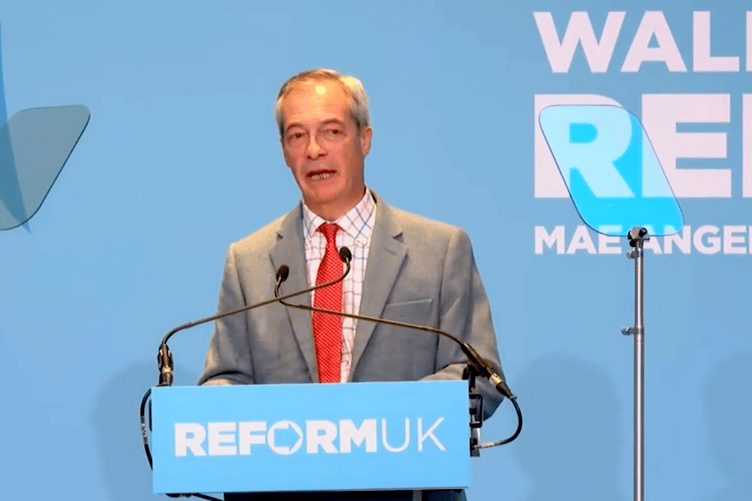
The demands to scrap net-zero targets come from parties like Reform and the Conservatives. Reform’s Deputy Leader, Richard Tice, even calls it “net stupid zero”. Reform is probably proud to be an extreme right-wing party; I prefer to call them false prophet party. Their audience is largely badly educated, people who believe things they wish to believe, including of course that immigrants and benefits claimants are to blame for everything that’s wrong in our country.
It’s opposition to immigration that brought Reform about, first in the guise of UKIP and then the Brexit Party. After Brexit they needed to figure out other policies in order to stay relevant. Being anti-environment proved popular. Hence their labelling the Green Party far-left and the green-wash parties such as the Liberal Democrats, Plaid Cymru, the SNP and the Labour Party, merely left-wing. What these left-of-centre parties have in common is that we see through Reform’s reckless rhetoric on immigration.
Simone Rossi, EDF’s Chief Executive in the UK, claims the UK’s energy policy is ideologically driven rather than by economics. I find this an odd statement. To me, economics and how we consume the planet’s resources is one and the same thing. Anybody with an ounce of common sense can see that our planetary boundaries are being stretched beyond their limits. Wanting to stop pollution of our rivers and accumulation of waste mountains, and having a clear plan for cutting damaging CO2 emissions through sharing resources fairly is rational economic thinking. It’s not driven by ideological conviction but by science.
The Conservative Party Leader Kemi Badenoch argues that markets, innovation and competition will deliver solutions to the climate crisis, not net-zero targets. The fact checking organisation, Carbon Brief, state that, “reaching net-zero emissions globally is the ‘only way’ to stop climate change, according to the Intergovernmental Panel on Climate Change (IPCC).”
Interestingly, that famous Conservative, Mrs Thatcher, was regarded as a right-wing politician, advocate of the free market and low taxation. Yet, Mrs Thatcher was also a scientist. She didn’t argue that banning CFCs, the ozone-depleting chemicals, was a left-wing policy. No, she recognised there was a major problem and became instrumental at bringing about a rapid end to the use of these chemicals.
More than that, she was keen to widen the international conversation to include climate change inducing chemicals. As a result of pressure, largely due to her personal commitment, the United Nations Environment Programme and the IPPC were set up in the late 1980s. The IPPC 2022 report argued that, “Emissions must peak by 2025 to limit global warming and reduce by 43% by 2030.” Would Margaret Thatcher be seen as a left-wing loony if she lived now? She’d very likely agree with the IPCC?


.jpeg?width=209&height=140&crop=209:145,smart&quality=75)
Richard Tice and Nigel Farage are not scientists. They’re prepared to gamble your children’s future. We’ve all experienced the terrible drought this summer. Yet that in itself doesn’t persuade certain people to take climate change seriously. Richard Tice insists that, “net-zero will make zero difference to climate change.” He prefers to blame other countries, usually countries that have a bigger population and countries that produce most of our consumer goods, like China. Or he offers geological explanations for a changing climate, ignoring scientific consensus.
Baroness Natalie Bennett argues that in the UK, “we are using our share of the resources of three planets” which is clearly unfair to poorer countries. She realises that in countries like ours difficult choices have to be made and that we cannot expect our poorest to cut two thirds of their consumption. If other so-called left-wing parties concede this, their politicians need to lead, be honest and help the country through the looming crisis. That means implementing fair net-zero policies urgently.
After the Second World War, the Labour Attlee Government implemented the Beveridge (a Liberal) report which set out plans for a welfare system that would tackle the five evils: ignorance, idleness, want, disease and squalor. We should all be proud of what left-wingers have created, not allow such idealism to be trashed by a bunch of ignoramuses.
Comments
We've recently changed our login process. If you have an account for commenting, you will need to re-register on the login window.
This article has no comments yet. Be the first to leave a comment.