

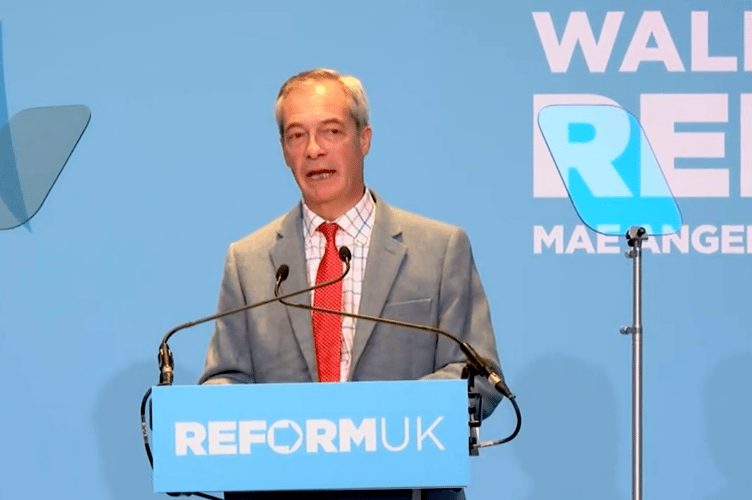
ANYONE planning to vote Reform presumably doesn’t care about humiliating themselves. After all, who with any self-esteem is going to align themselves with a collection of political novices, barely recognisable as a party, fielding candidates no-one has heard of and about whom they know nothing?
To be fair, with the advent of Wales’s ultra-enthusiastic embracing of all-out proportional representation, Nigel Farage’s creation is not alone in making use of carpetbagging. But then, putting up candidates in areas where you have no local connection goes to the heart of depersonalisation, which is central to the PR system based on vast new voting regions dreamt up for tomorrow’s Senedd elections.
It’s just that Reform does the mystery candidates act with particular panache. As this column has noted, the party’s Ceredigion Penfro single-sheet election communication - at least the one that came through my letter-box - is a model of information on iron rations, consisting of little more than a few bland words from Farage mentioning nothing specific about any of the multitude of issues and problems besetting rural Wales.
Not a scintilla of stuff was there about the identities of any of the six candidates on its constituency list. Equally unforthcoming on this rather basic matter is Reform online. Can it be they are so lukewarm about their chances in Ceredigion Penfro they can’t be bothered to make even a token effort to sell themselves?




Or are they just anticipating a moment when the Senedd determines that backbench members, at least, will henceforward surrender personal identities and instead be issued with numbered t-shirts (blue to show up nicely on television, XXL available)?
It turns out that top of the Ceredigion P Reform list is one Susan Claire Archibald, followed by someone called Paul Marr. Yes, indeed. Who are these Farage disciples? A three-minute prodding of the internet indicates Ms Archibald is a member of Pembroke Town Council and a former director of Warrington-based SDM Site Contracts Ltd. On Mr Marr, I draw a blank.
If I vote for them, I will be backing people no more substantial than wraiths in a moonlit churchyard, belonging to a party so inept it gets two of the three Welsh words on the front of its Wales manifesto wrong. There must be better destinations for the cross on my ballot-paper.
The point is obvious. Are we going to allow anonymity and non-engagement to be the hallmark - certainly, at least, as far as Reform is concerned - of the brave new politics to be unveiled tomorrow?
Politicians need to understand very clearly indeed that politics, if it’s in working order, is actually all about personal interchange. And that without that it’s dead, down the drain, and with it, in any meaningful way, democracy. It’s true that parties other than Reform named and gave limited details about, candidates, but information was scant.
Backers of the new voting system think it will deliver results more reflective of voter choice. The drawback is that people will likely feel alienated by the sheer size of the new regions. An alienated voter is like a nail in the coffin of people-power.
Continuing with, as an example, Ceredigion Penfro, it’s a safe bet that people living either in Ceredigion or in Pembrokeshire will feel no close affinity with places at opposite ends of their new electoral territory. As with voters, newly-elected SMs living in south Pembrokeshire (and that’s where a majority on party lists live) will probably know little, if anything, about life in north Ceredigion. Minor parties may end up with more SMs, but what will be the quality and the nature of the representation they offer?
This may not be the end of the story. Constituencies may have to be redrawn again to eliminate the cultural and geographical disaffection that it seems almost inevitably will flow from the new carve-up. It won’t be the end of Senedd proportional representation, but revision there may have to be.
The new arrangement set out for voters tomorrow is politics invented at a series of meetings, often in private, between Welsh Labour and Plaid Cymru as part of the parties’ 2021 cooperation agreement.
In October 2021, a so-called special committee was set up consisting of five Labour and five Plaid members, and the presiding officer - llywydd - of the Senedd, Elin Jones, who heads Plaid’s Ceredigion Penfro list in tomorrow’s election.
In 2022, a joint position statement was published by then first minister Mark Drakeford and Adam Price, Plaid leader at the time. The two called for a 96-member Senedd, all elected through closed party list proportional representation, using the wretchedly complicated D’Hondt method.
In its final report in May 2022, the committee backed the system agreed by the Labour and Plaid leaders, and the following month the new arrangement was approved by the Senedd in a 40-15 vote - a less than reassuring majority.
The appearance now is of candidates selected by parties centrally being viewed by party executives essentially not as people but as numbers. Numbers on lists that voters have been persuaded to accept as evidence that the party - any party - knows best.
At the core of this scarcely acknowledged revolution has been an apparent intention to weaken the accountability of SMs by virtue of the fact that voters are being told they are now required to align with parties, not candidates. This is a massive, and high-handed, shift in the nature of democracy in Wales. History of a dubious kind is being made.
The closed-list system reaching full fruition in tomorrow’s poll is thus the culmination of a decision, crucially without voter consultation, to concentrate power at the centre, plucking it away, to a significant extent, from voters and SMs.
After the Senedd vote of June 2022, there were dark, clearly unproven, murmurings that the design of the new voting system appeared to ensure power in perpetuity for Welsh Labour or Plaid or the two in combination.
There seems little likelihood that that contention will now ever be proved one way or the other. Because since then there has appeared what no-one could have foreseen - the emergence of Reform as the joker in the pack.
Comments
This article has no comments yet. Be the first to leave a comment.