
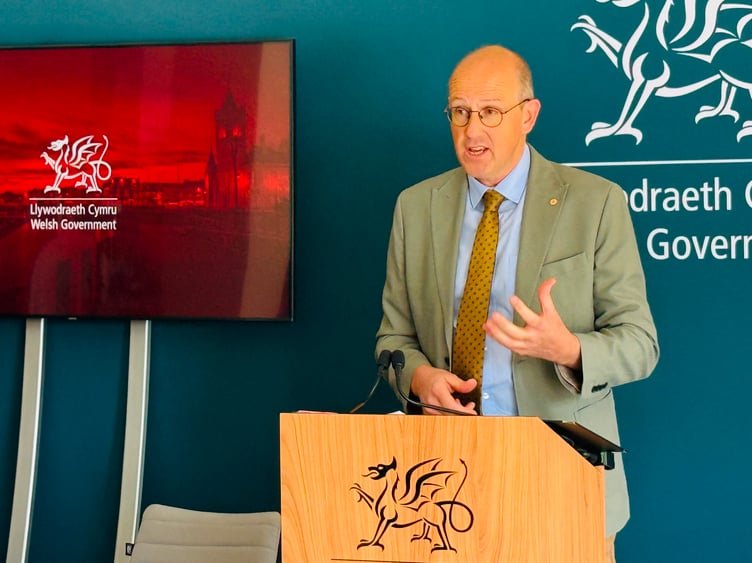
LLYR GRUFFYDD intends his new Welsh food strategy to be searchingly comprehensive, encompassing everything from production to consumption.
It makes a good stab at being so, its inclusion of health, education, public procurement and the circular economy being particularly fresh and welcome.
Trouble is, the rural resilience and sustainability minister doesn’t mention East Anglia. And, without a close examination of what’s going on there and in the rest of Britain’s grain-growing regions, any analysis that includes Welsh food-security will be half-baked.

Less than three per cent - about 22,000 hectares - of farming land in Wales is used to grow cereals. This makes the country heavily reliant on grain crops, particularly wheat, grown in the east of England, long known as Britain’s bread-basket.
But wheat production there is in deep, and deepening, trouble. One reason is obvious: the serious toll on yields taken by increasingly regular extreme heatwaves and prolonged droughts. Climate chaos has arrived, and is as ferocious as decades of warnings said it would be.
The UK is this year consequently heading towards its worst cereal harvest since comparable records began in 1984, following one of the hottest and driest growing seasons on record.
Analysis by the Energy and Climate Intelligence Unit, based on preliminary estimates from the Agriculture and Horticulture Development Board (AHDB), show the country as a whole could see a deficit of as much as 2.5 million metric tons of cereals and oilseeds.
Average wheat yields so far this year are down 13 per cent compared to the UK five-year average, according to the AHDB, this following below-average harvests in 2024 and 2025. In 2023, wheat acreages fell by 5.1 per cent, with that year’s 14 million tonnes harvest 10 per cent lower than in 2022.
The numbers point to how the new climate’s extreme weather is increasingly reshaping farming production and, consequently, global grain markets.



Two summers ago, this column warned that the importance of food-security, and the looming prospect of some food shortages, meant Wales should take more than a passing interest in the Starmer government’s plan to concrete over large chunks of English countryside, inevitably including arable farmland, to meet its promise to build 1.5 million homes within five years.
Since then, the picture has worsened. A crazy plan for a new city for a million people on 57,000 acres of farming land east of Cambridge has emerged, and a separate proposal for 23,000 homes, also on agricultural land, west of the city. Meanwhile, thousands of acres of grain-growing soil are being concreted over by new housing estates. So, a lot more people and a lot less grain to feed them, and everyone else, with.
The climatic and building development threats to future production levels of grains that are as much a staple of human, and livestock, diets in Wales as anywhere else in the UK is blindingly obvious.
This is not to make an alarmist prediction that breakfast toast is about to become a folk memory. The rapid acceleration of climate chaos, however, seems to have taken governments by surprise. We would look pretty stupid if we were now ambushed by a grain crisis we should have seen coming.
Llyr Gruffydd should be chewing the cud on this issue with the Burnham government. He could also seriously consider the feasibility of Wales’s grain production being stepped up, while noting existing community-level efforts in Wales to grow and use grains locally.
But, for a start, it would be nice to know he agrees we’ve got a rather serious problem on our hands.
The stars are aligning...
SOD’S LAW it’ll be cloudy this evening when we alight in the Elan Valley with foldaway chairs and sandwiches for the celestial fireworks.
Never mind, better to be deposited on a damp and chilly hillside at dusk to no avail than to gamble on still being wrapped in this mortal coil 27 years from now and discovering - too late - that we aren’t.
Twenty-seven years is how long you’d have to wait for a repeat performance of today’s and, perhaps, lingeringly, tomorrow’s hyper-dramatic meteor shower, which, after sunset, could see over 100 shooting-stars an hour streak across remote and dark mid Wales skies mercifully beyond the range of light pollution.
These thrilling explosions of light are perhaps the main event of the night, which is not to diminish the preceding spectacle of a partial solar eclipse - the moon passes in front of the sun - which begins at about 6.15pm.
In the midst of such euphoria, however, it’s infuriating that the moon continues to be under outrageous assault from Earth, with huge damage being inflicted, both intentionally and by accident, by space-probe rockets.
The latest incident came last week, when a four-tonne piece of a discarded SpaceX rocket crashed into the moon at 5,400mph, gouging out a crater 18 metres wide and four metres deep and kicking up a miles-long plume of lunar dust.
It was futile for Nasa to claim blithely that the impact posed no danger to Earth. Are they really so omniscient as to be able to know that? But perhaps the more important point was that the statement seemed to infer a certain arrogance: well, you know, if we choose to blast a vast hole in the moon’s surface, that’s nobody’s business but ours.
This was just the latest piece of lunar vandalism inflicted by multiple spacecraft since the 20th-century space-race.
In 2009, Nasa intentionally smashed a rocket stage into the moon to study the plume of debris set loose. In March 2022, part of a Chinese rocket ploughed into the surface. In 2019, a section of an Indian rocket slammed into our incalculably precious moon, and in 2023 a similar assault was perpetrated by Russia’s Luna-25 mission.
Extraordinarily, no-one seems to think these highly destructive assaults matter. Trashing our nearest celestial neighbour, an entity at the centre of cultural and romantic tradition since time immemorial, which controls tides on Earth and is an enduring symbol of mystery and wonderment, passes unnoticed. Not a whisper of protest is heard.
We need to wake up to the destruction our silence is sanctioning. The moon must not be regarded as a freely available resource ripe for exploitation by money-grubbing, philistinic industrial/commercial interests.
Some things should be sacrosanct. The moon is one of them.
Comments
This article has no comments yet. Be the first to leave a comment.