

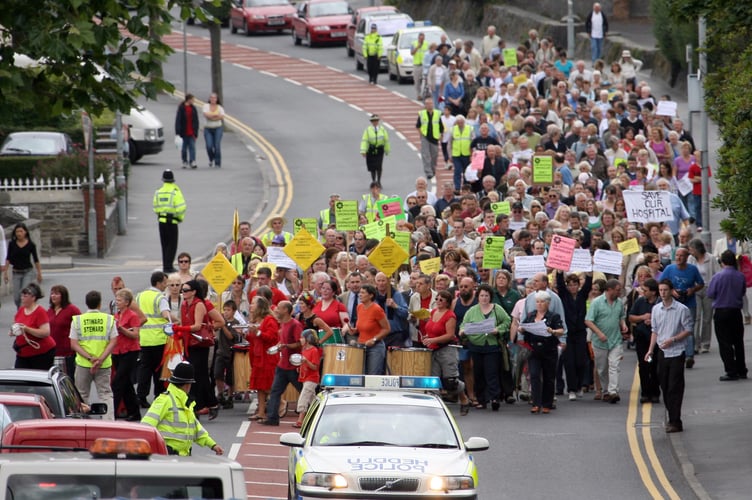
HYWEL DDA health board is unfit for purpose.
The levels of anger and anxiety generated over its mad plan to ruin Bronglais Hospital’s celebrated stroke unit point to an urgent need for radical change, and the new government Wales gets in May must see to it that that is exactly what happens.
The health board deals with matters of supreme public interest and importance yet is totally lacking in clear lines of democratic accountability.
Weakly, Eluned Morgan’s government has added to the public’s lack of influence by abdicating responsibility to assert meaningful overall control and directioning of the board’s policies and actions through informed and perceptive oversight.


As a result, the board has got away with blue murder, vast areas of rural Wales suffering inequitable allocation of health services and resources compared with other parts of the country.
The democratic content of the board lies somewhere between wan and non-existent. It consists of 13 so-called ‘independent’ members appointed, formally, by the health minister, but to all intents and purposes chosen by an advisory panel (unelected) comprising the health board chair (unelected), an ‘independent’ member of the panel (unelected) and a member of the Welsh government’s health, social care and early years group (unelected).
Although the board’s catchment extends from its core area of Carmarthenshire, Ceredigion and Pembrokeshire into Powys and Gwynedd, none of its ‘independent’ members appear to live anywhere north of south Ceredigion, meaning none are likely to understand first-hand what it’s like to survive under a Cinderella health service.
There seems every reason to believe these carefully vetted people sing other than from a hymn-sheet drawn up by senior health board officials.
I sent messages to all 13 ‘independents’ asking whether they would vote in defence of Bronglais’s stroke unit or for the board’s ‘treat-and-transfer’ and received not a single reply. I managed to get through to a couple of these apparent cyphers by phone and encountered people who not only wouldn’t answer the question but clearly wanted to maintain absolute silence on the matter.
I was told by the board: “Independent members are not prevented from talking to the press or media. However, as with all media enquiries, these are coordinated through the media office team.”
For “coordinated” read controlled.
If this health board’s management by diktat is to end, the most basic requirement is for members to be elected by the public. At the moment, all we have is a grouping no more independent than a well-trained sheepdog doing a shepherd’s bidding.
Alternative stroke plans are red herrings
IN A feeble and wholly inadequate attempt to quell fierce protest over downgrading of the Aberystwyth stroke unit, the health board last week announced two “alternative” options for future services.
The first would still see patients subjected to its potentially dangerous ‘treat-and-transfer’ plan but would, the board claimed, include establishment of a “stroke rehabilitation unit”.
The second “alternative” option would, it said, mean Bronglais would have a stroke unit but one, crucially, with specialist cover for only 12 hours a day. This is plainly unacceptable. Strokes don’t observe a 9-5 regime.
Under one of the two original options, stroke patients in the huge rural Bronglais catchment would be transferred to a distant Prince Philip Hospital, Llanelli, where a stroke unit would have specialist cover 24 hours a day.
With the second of the board’s new options offering a mere 12-hour specialist cover for Bronglais, the struggle to safeguard the present highly-praised unit is far from over. It should certainly not be abandoned in the face of a partial and grudging climb-down by a clearly rattled health board.
The latest options are marked by lack of detail, with both presented only as a diagram.
Ceredigion MS Elin Jones, for years an ardent campaigner for Bronglais, tells me she believes that, if either were adopted by the board, a new round of public consultation would be needed.
“Both options retain an element of stroke service at Bronglais, partly at the expense of both Llanelli and Withybush.
She adds, perhaps rather too politely: “I think this is now confusing for all concerned and I would hope that the board recognises this, draws a line in the sand and commissions a new piece of independent analysis on running a stroke service over a very large rural area, recognising the need for early specialist intervention and accessible, longer-term rehabilitation.”
At one level, the fresh options illustrate the half-baked thinking of a health board heavily in the red - by about £24m - yet showing a willingness to engage in profligacy by producing, at a cost of an estimated £300,000, a set of deficient proposals now destined for the shredder.
Mabon’s mastery of political silence...
WITH Plaid Cymru in a probably unassailable position in the polls, it’s a pretty safe bet that Mabon ap Gwynfor will wake the morning after May’s Senedd elections and find himself health secretary.
If he does, and if Hywel Dda health board has, despite tumultuous protest by the public, medical professionals and politicians, embarked on a dismembering of Bronglais’s superb stroke service, he will have to come to the rescue.
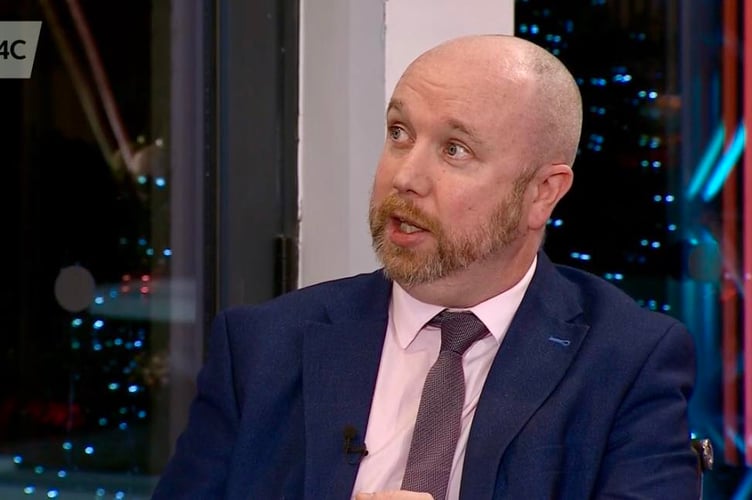
Mabon ap Gwynfor, grandson of Plaid’s first MP, Gwynfor Evans, has been, with Ceredigion MS Elin Jones, and an army of other protesters, a keen defender of Bronglais and a vocal opponent of the board’s abominable ‘treat-and-transfer’ plan. He has been Plaid’s health and social care spokesman since mid-2023.
I asked him whether, if the worst came to the worst, he as minister would, without delay, both order reversal of any downgrading decision by the board and order it to immediately work towards an enhancement and strengthening of the stroke unit.
His reply was disappointing.
He tells me: “If Plaid Cymru is in government after May’s election, then this will obviously be an issue that a Plaid health minister would wish to raise immediately with the health board.
“However, I cannot comment on what I would do personally, primarily because I don’t know whether I would be that minister.
“Also, I would need to be careful not to prejudice any ministerial decision at this stage - and it may well be that, as a local member, having already expressed strong views on this matter, I would not be able to act as a minister on this matter.”
This is faulty thinking.
The fact that he has been Dwyfor Meirionnydd MS since 2021 and has backed Bronglais and attacked ‘treat-and-transfer’ would not prejudice a ministerial decision to order reversal of a policy potentially lethal to stroke patients in a large part of Wales. Indeed, it would be remiss of a health minister not to act.
This would not be a constituency issue but an all-Wales judgment based on equity of health service provision, and taking into account current geographical disadvantage.
Further, it is perfectly obvious as objective fact that health services in Ceredigion, western Powys and southern Gwynedd have for decades been neglected by Cardiff governments and, before that, by the Welsh Office. Prejudice here is not an issue.
Plaid’s record over backing Bronglais is in fact particularly good. Major victories have included Elin Jones’s defensive exercise in 2005 and 2006, when the health board tried to strip the hospital of its consultant obstetrics, 24-hour surgery and full accident-and emergency services.
Protests included formation of Arbed Bronglais Emergency Rescue and, when Plaid went into government with Labour in 2007, the plans were duly scrapped and all three services are now firmly established at Bronglais. These are triumphs heavily down to the energy and determination of Ceredigion’s MS.
Comments
This article has no comments yet. Be the first to leave a comment.