

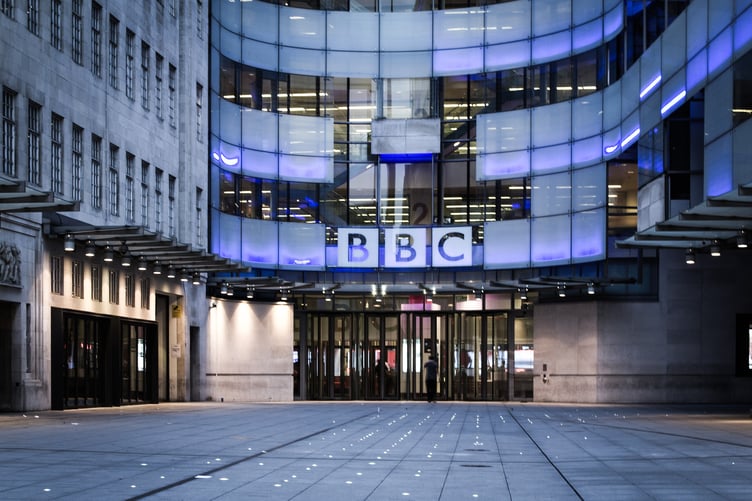
THE WEIGHT of snarling and judgmental accusations of journalistic bias in BBC output generally, following a single dishonest piece of editing of a Donald Trump speech, is crazily disproportionate.
Yes, Panorama shouldn’t have doctored statements made by Trump, 50 minutes apart, in advance of the riot of 6 January 2021, when a mob attacked the US Capitol. It shouldn’t have spliced the two comments in question. But it’s patently silly to allow this one blunder to be a catalyst for a wholesale, and sometimes sanctimonious, hatchet-job on the BBC’s overall news output over umpteen years, which has been nothing less than admirable.
Certainly, this column has grumbled about instances of perceived unfairness in the BBC’s coverage - for example, of the hospital doctors’ fair pay campaign - more than once, but never to the extent of inferring anything but wonderment over its overwhelmingly proud record of journalistic integrity.
Really, there’s no justification for the frankly hysterical way this sorry lapse is being presented. For example, by ex-BBC political editor Andrew Marr, who excitedly hoists it as “an international story which affects Britain’s reputation round the world, with Tel Aviv, Moscow and Washington…joining in the kicking.” Oh, come on, Andy, keep a sense of proportion. In any case, you need to acknowledge that, of those three, Tel Aviv and Moscow are usual suspects when it comes to denigration of the BBC. When is Israel or Russia likely to have been other than pissed off by the corporation’s coverage?



As for Washington, its verdict is presumably inseparable from the issuing of that multi-billion lawsuit threat against the BBC.
Closer to home, I hope Cambrian News contributor Patrick Loxdale won’t take it badly if I query the assertion in his column of 19 November (What’s gone wrong at the Beeb?) that “the BBC seemed willing to take the words of Hamas to be gospel truth in Gazza, whilst rather too easily dismissing what the Israeli Government had to say.” Funny, that’s decidedly not what I took away from broadcasts relating to that elongated bloodbath. Despite the severe handicap of being barred from Gaza by Netanyahu, every utterance by the BBC’s people suggested nothing but a scrupulous adherence to the facts.
His view may or may not chime with an emerging consensus over recent weeks which seems to be that, overall, BBC journalists are a bunch of lefties. Yet accusations of bias can be credible only when supported by careful analyses of evidence. The left-leaning supposition, for instance, is not supported by a 2013 study by Cardiff School of Journalism, Media and Cultural Studies, which fund that the BBC tended to put out “a Conservative, Eurosceptic, pro-business version of the world, not a left-wing, anti-business agenda”.
At the same time, the BBC has been for as long as anyone can remember a magnet for politically engaged graduates, who will overwhelmingly have been recruited as journalists by kindred spirits already embedded at the corporation. New recruits may be left or right-leaning, or politically perpendicular. My guess, without offering any evidence, is that a majority will hold views which can be summarised as liberal, and therefore centred on freedom, social justice, individual liberty and citizen rights. On that basis, I’m all for a BBC with a liberal bias.
To try to lighten the mood, how about the following: in the early days of the BBC-Trump fandango, the president’s’s press secretary, Karoline Leavitt, said the BBC was “100 per cent fake news”. Yet it’s an incontrovertible fact that, among the reams of BBC stories about America, will have been the statement in 2024 that Donald Trump had been re-elected. So either he was not in fact re-elected, or the “100 per cent” statement is wrong. His presidency we know is a fact, so will the BBC sue?
Finally, some good news about Aber
ABERYSTWYTH becomes Wales’s first UNESCO city of literature. A fine and welcome counter-balance to a sense of perma-crisis over such as NHS services - predominantly the threatened serious downgrading of stroke services; the desecration of the Welsh countryside through a proposed proliferation of wind-turbines and pylons; and a £560m local government funding shortfall.
Culture and creativity to bring perhaps a stimulating divergence from the everyday. Writing, reading and local publishing to be celebrated.
A great pity then that Ceredigion council should have chosen this precise moment to cut by four hours a week opening hours at Aberystwyth public library. Also the very worst time of the year to take this backward step, given that everyone knows the town’s elegantly-housed library is depended on as a well-heated place of refuge, quiet socialising and cultural interest by people struggling, because of persistently high energy bills, to keep warm in the cold weather.
Never mind, councillors’ access to their nicely heated offices will not be restricted and, anyway, they can rub their hands with satisfaction - as opposed to as a way of keeping warm - over their latest, entirely unearnt, pay rise.
Comments
We've recently changed our login process. If you have an account for commenting, you will need to re-register on the login window.
This article has no comments yet. Be the first to leave a comment.