

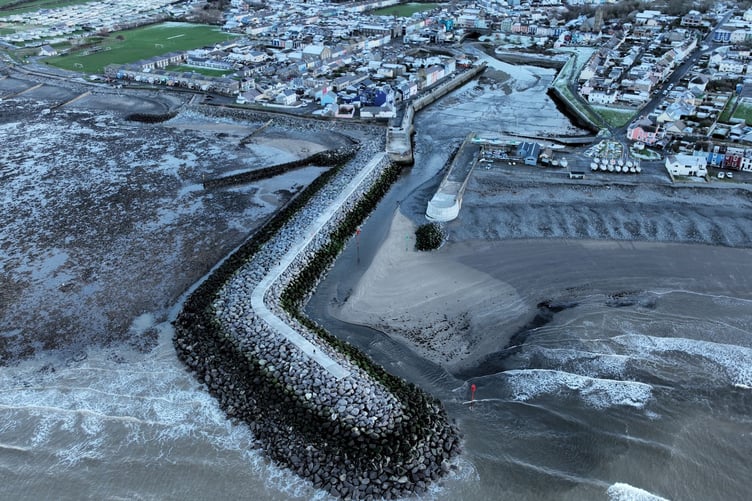
CEREDIGION council has every reason to feel very cross with Nature.
Specifically with its tides and ocean currents division, and the way it’s let the side down very badly indeed over the council’s newly completed £36m coastal-defence project at Aberaeron.
Crucially, this has included a chunky new southward-facing breakwater extending out of the harbour-mouth. Key to the design, this structure is now at the centre of a protest of tempestuous proportions which seems likely to drown out any prospect of praise for the council’s endeavours. And it’s all Nature’s fault.
While there’s general agreement that the completed scheme will protect more than 100 homes from flooding, there is more than a ripple of unrest among boat-owners that the southerly aspect of the breakwater has led to the formation of a massive shingle bank in the harbour entrance, making the harbour impassable to all but dinghies.




Bluntly, mariners charge that the breakwater has been mistakenly designed, that it faces the wrong direction and is thus unable to block predominant and powerful south-westerly swells.
Which is where Nature’s treachery comes into focus. Since time immemorial, these seas have been the ruling force along this part of Cardigan Bay. Knowing this, the council and its contractors went out of their way to persuade Nature to change its eons-old habit and swing round to a predominantly north-westerly routine, so that invasive shingle, silt and sand would heave in against the northern - outer - side of the new breakwater, so avoiding the dramatic blockage of the harbour which has instead materialised.
After much swishing and sloshing between traditionalists and progressives at a specially convened meeting of the tides and ocean currents division, the progs secured a slim majority of votes and their decision was ratified by Nature’s senate.
At the eleventh hour, however, when the council’s contractors had irrevocably swung the breakwater southwards, an adequate number of tidal rebels did a volte-face and announced that tradition would be maintained.
It’s this perfidy that has ushered in devastating suggestions by Aberaeron’s disgruntled harbour-users that the breakwater was too big and was designed to work against Nature rather than with it. Would that they knew of Nature’s broken undertaking.
Worse, the council was accused of not understanding elementary geography on the subject of longshore drift. That’s the phenomenon children learn about at school and concerns the driving of sand and pebbles along a coastline by waves hitting the shore.
One critic, Bryn Raw-Rees, a local surfer who has used the harbour for 30 years and is a former geographic analyst, referred embarrassingly to “GCSE-level geography” and insisted the project had interrupted a predominant south to north longshore drift.
He expanded: “This has created two new accretion zones as the natural transport of sediment has been prevented. The mound will keep getting bigger, as will the sandbank, until the south-to-north transport of sediment can happen again. The shoreline north of the breakwater will also be sediment-starved.”
The council has conceded it will now have to foot the bill for dredging the harbour entrance, presumably a necessarily regularly repeated exercise that, whether through council tax or the Welsh government, will be a tab picked up by the taxpayer.
Moral of the tale: don’t hesitate to rely on the unreliability of Nature.
How do you deal with the likes of Trump?
WE WILL likely find that Donald Trump’s dismissive attitude towards international law will at some point be brought up short by mounting moral indignation on the part of countries so far restrained by fears of retribution or retaliation.
Much of the world beyond Washington DC will progressively be stung into emerging from the shadows by the realisation that their carefully modulated observations about the importance of a rules-based order are inadequate in the face of recent US actions.
If it’s not barging into Venezuela and holding out the possibility of military action against Colombia and Cuba, or talking of taking Greenland from Denmark, it’s been the seizure of oil-tankers in European and Caribbean waters.
Taken off-guard, world leaders found themselves trying to work out how to handle the president’s revived form of US imperialism. Almost as one, the decision was to pussyfoot around he who must not be offended.
It’s hard to see that kind of feebleness continuing since, in addition to the necessary expression of moral indignation, restraint will ultimately do countries a disservice because it will be taken as a sign of weakness, a quality likely to be pounced on by the White House.
Arguably, countries should have seen coming the present escalation from aggressive rhetoric to shocking action. Then again, America has form when it comes to toppling neighbouring regimes it doesn’t like. In 1983, Ronald Reagan overthrew a leftist government in Venezuela’s near neighbour Grenada, a member of the British Commonwealth, and in 1990 George H W Bush captured Panama’s president Manuel Noriega, claiming he was a drug lord.
What’s newly alarming in Trump’s current muscle-flexing is his ambition to take over minerals-and-oil/gas-rich Greenland, despite stunned rejoinders by Denmark and the inhabitants of its autonomous territory that the idea’s a non-starter. But perhaps Trump the gadfly, with a little persuasion from whatever friends the US has left, will simply lose interest and settle on another project that risks engendering fear and loathing.
Comments
We've recently changed our login process. If you have an account for commenting, you will need to re-register on the login window.
This article has no comments yet. Be the first to leave a comment.