

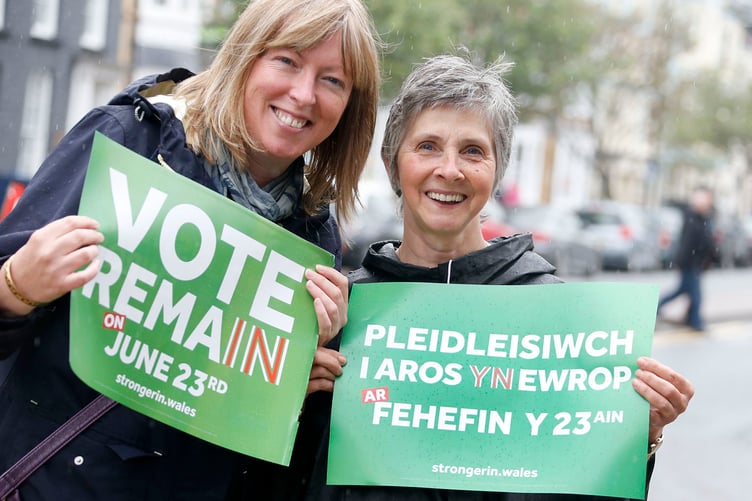
On 23 June 2016, the UK voted to leave the European Union, with promises of ‘taking back control’, more investment, a better NHS and more freedom for farmers.
10 years on, have we seen the benefit of the decision to leave the European Union.
Ceredigion and Gwynedd were two of just five Welsh counties that voted to remain within the European Union with 54.6 per cent of residents in Ceredigion voting remain and 58.1 per cent in Gwynedd.
53.7 per cent of Powys residents voted leave as did 57.1 per cent of those in Pembrokeshire, with Wales as a whole voting to leave
.jpeg?width=209&height=140&crop=209:145,smart&quality=75)


Ceredigion was lauded as being the most Europhile county in the UK before the vote and was a significant net benefactor from being a member of the European Union, be that through education with the two universities, agricultural subsidies and with the region having areas considered some of the poorest in all of Europe, therefore benefitting from Objective 1 funding.
A recent YouGov poll indicates that just 30 per cent of Britons believe that the UK was right to vote to leave the EU, while a clear majority (57%) now think that Britain made the wrong decision in June 2016.
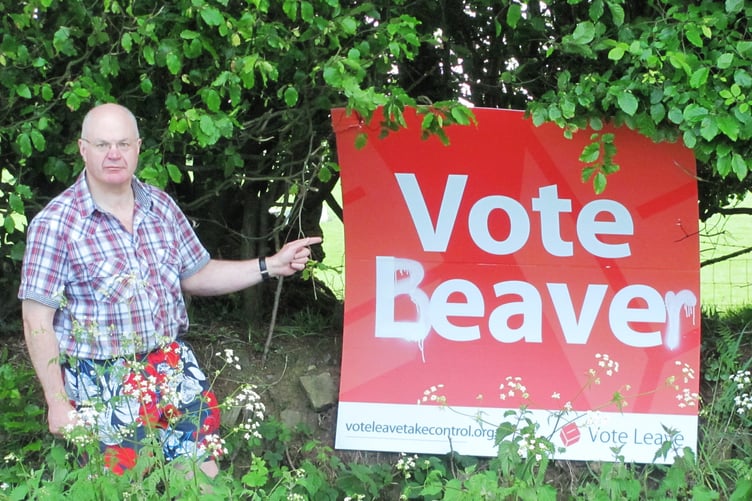
The impact of going it alone has been felt keenly in rural Wales.
Reflecting on the landscape 10 years on from the vote, Professor Michael Woods, Director of the Rural Wales Local Policy Innovation Partnership at Aberystwyth University, said: “Before Brexit, west Wales qualified for the highest level of economic development support from the European Union. This brought in over £1.6 billion in funding between 2014 and 2020 and helped to fund Cardigan Castle and Nant Gwrtheyrn Heritage Centre. That funding has been replaced by the Mid Wales Growth Deal, the Shared Prosperity Fund and the Levelling Up Fund, which has given money to the Old College Project in Aberystwyth for example, but there is more complexity, less stability and less money overall.
“One of the biggest changes has been the end of the EU Rural Development Programme, aimed at diversifying the rural economy.
“This worked through a community-led approach, through so-called LEADER groups such as Cynnal y Cardi, supporting the ‘soft infrastructure’ in many small towns and villages.
“Although Ceredigion Council has continued Cynnal y Cardi with UK Government funding; the Welsh Government dropped community-led rural development, leaving a gap. As the new Welsh Government is pledged to introduce a new Rural Development Programme, it will be interesting to see if this approach is revived.”
Dr Rhys Dafydd Jones and Dr Jesse Heley, from the Department of Geography and Earth Sciences at Aberystwyth University, added: “Brexit brought a lot of uncertainty.
“The three-and-a-half years between the referendum result and the UK’s eventual withdrawal saw a lack of assurance of what kind of Brexit (‘hard’, ‘soft’, or indeed ‘oven-ready') would take place.
“For EU citizens resident in the UK, this uncertainty raised questions about what rights and responsibilities they would have after Brexit.
“The campaign also made many feel that they no longer belonged in a place they’d lived and worked in for years, sometimes decades.
“Evidence from our Leverhulme Trust project, Living Brexit in Rural Britain, suggests that many workers from EU countries have consequently left rural Wales.
“This has led to labour shortages and in some instances this workforce has been partially replaced by immigrants from further afield. The referendum also brought tensions within communities.
“Many people attempted to ‘manage’ the situation by not discussing Brexit and avoiding places where they felt conversations could become difficult. This has had a knock-on effect in terms of social engagement and cohesion, with social and political rifts extending beyond migrant populations and into the wider community.”
The sentiments are echoed by our local politicians, who say we must learn the lessons from the past decade.
Plaid Cymru MP for Dwyfor Meirionnydd, Liz Saville Roberts, said: “Ten years on from the Brexit referendum, it is clear that the promises made to communities like ours in Gwynedd have not been kept.
“We were told that leaving the European Union would bring prosperity, stronger public services, and greater control - but for many people, the reality has been very different.
“Areas like Dwyfor Meirionnydd relied heavily on European funding to support jobs and investment.
“What has replaced it simply does not match the scale or certainty of what we had before.

“The form of hard Brexit pursued by the last UK Government has cost the Welsh economy up to £4bn, with Brexit reducing the value of Welsh exports by up to £1.1bn. The result has been fewer opportunities, particularly for young people who want to build their futures here at home.
“Farmers were promised that they would not be worse off, yet many now face increased costs, labour shortages, and more complex export arrangements.
“£1bn has been lost to Wales in the form of European structural and rural development funding. Small businesses that once traded freely with our nearest neighbours have been burdened with red tape and uncertainty.
“These are not abstract issues - they are real pressures being felt every day across our communities.
“We have seen a narrowing of opportunities for students, fewer chances for collaboration in research, and a reduction in the cultural exchange that once enriched our communities.
“For a nation like Wales - outward-looking and internationally connected - this has been a step backwards.
“While we cannot turn back the clock, we must learn the lessons of the past decade. That means being honest about the impact Brexit has had and working constructively to rebuild closer ties with our European neighbours in areas that benefit our economy, our communities, and future generations.
“Returning to the single market and customs union would be the best way to begin to undo the economic damage inflicted upon our communities.
“However, under Keir Starmer Labour are disappointingly resolute in refusing to acknowledge this starkest of economic realities.
“The people of Gwynedd deserve better than what has been delivered over the last ten years.”
The Welsh Liberal Democrats have unveiled their plans near the 10 year anniversary to join the single market and boost defence ties with the EU.
Welsh Liberal Democrat Westminster Spokesperson David Chadwick MP said: “Wales was one of the hardest hit parts of the UK by the failed Brexit experiment that was masterminded by the likes of Nigel Farage and Boris Johnson. It’s costing UK taxpayers £90 billion a year.
“Now, the same politicians who got us into this mess are telling us that it doesn’t matter how bad it gets, the country cannot question our relationship with Europe.
“We shouldn’t have to live with the bad deal they’ve lumped us with, people deserve far better than that.
“That’s why we are calling for a bold new deal with Europe to boost growth, create jobs and keep our country safe. It’s the first major step towards giving our children a better future, fixing the cost of living crisis and getting our country back on track.”
YouGov data compiled this month says Brexit is widely perceived to have been more of a failure than a success, with the number thinking the former outnumbering the latter five times over (61% vs 12%), with a further 19% believing it’s neither been a success nor a failure.
Only a quarter of those who voted to leave the EU (25%) the project they endorsed has been a success, with this still only rising to 36% among those who continue to believe that Britain was right to vote to leave the EU (although only 15% actively believe Brexit has been something of a failure).
Even among those who voted for Reform UK at the last general election, roughly as many see Brexit as having been more of a failure (24%) than see it as having been a success (29%), though with the most common view among them being that Brexit has been neither a success nor a failure (44%).
Conservative voters tend to feel Brexit has been a failure, by 36% to 25%, while 82% of Labour and Lib Dem voters think it has ultimately been a failure, alongside 87% of Green voters.
In principle, a majority of Britons say they support rejoining the EU (55%), with only a third of the public (34%) being opposed to undoing Brexit. This includes nearly a quarter of 2016 Leave voters (23%) approving of a return to the EU, a proportion roughly twice as large as the 12% of Remainers who would oppose a return to full membership.
However, some EU officials have said it’s unlikely the UK would be able to simply rejoin on its previous terms, which included significant opt-outs from EU policy. Instead, the UK could be required to join the Euro and participate in the Schengen passport-free travel zone.
Were this the price for re-entry, Britons are instead much more divided on whether or not to rejoin, with support for becoming a full EU member falling twenty points to 35% and opposition rising ten points to 43%.
Beyond full membership, Britons tend to support rejoining the single market and customs union, by margins of 50% to 24-26%, though it is a closer relationship without formally rejoining any of the EU’s key aspects that truly commands the most popularity.
Six in ten Britons (59%) say they support the UK having a closer relationship with the EU, without rejoining either it, the single market or the customs union, while just 20% oppose such a path.
Nonetheless, a closer relationship on such terms has cross-partisan support; by 70% of Remainers and 54% of Leave voters, as well as by 61-73% of those who voted Conservative, Labour, Lib Dem or Green in 2024. Reform UK voters are the sole exception, being divided 39% to 43%.
Ultimately, just 29% of Britons support Britain’s relationship with the EU remaining as it is, while only 21% would like to see a further loosening ties with the European Union.
In November last year before the recent election, Senedd committees warned that Wales has been “hurt hardest” by Brexit amid a “mess” of trade barriers, cultural blockades and a “fading” Welsh presence in EU relations.
The economic impact was severe with the EU remaining the biggest trading partner, accounting for 47% (or £17.6bn) of Wales’ total trade in goods, with 90% of businesses are still dealing with challenges, including increased bureaucracy, costs, time, and supply chain disruption.
Speaking on how the country moves on and the political sea change we face today, the Institute for Government writes: “In 2019 the two traditional governing parties gained 76% of the popular vote: that had fallen to 58% at the 2024 election and all subsequent electoral tests have suggested it has fallen further with the rise of Reform UK on the right and the Greens on the left.
“There have now been six prime ministers since that momentous vote in 2016. None has served anything close to a full term in office and, at the time of writing, it is not clear if the first non-Conservative to hold the post will either. That may not be because of Brexit, but it is hard to say that the change in politics of the past 10 years won’t have played a part.”
Vera Spyrakou from the London School of Economics added: “A decade after the referendum, the central question is no longer about Britain leaving the EU, but about how both Britain and Europe can continue to redefine democracy, political belonging and collective resilience in an age shaped by geopolitical instability and deepening interdependence.”
Comments
This article has no comments yet. Be the first to leave a comment.