

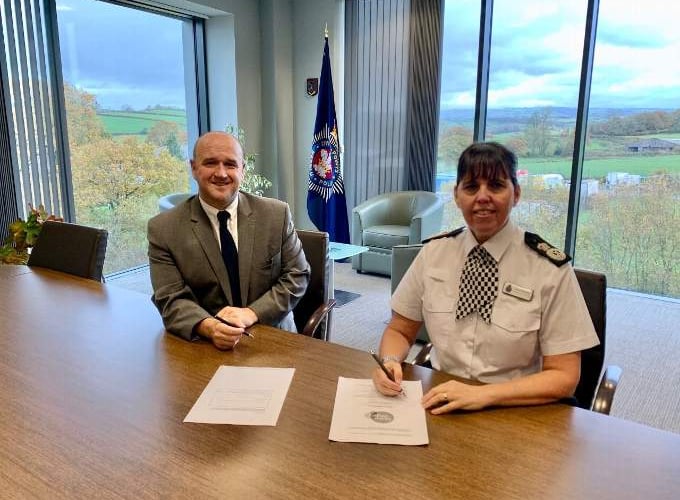
DYFED-POWYS Police and Crime Commissioner Dafydd Llywelyn and Temporary Chief Constable Claire Parmenter have confirmed that Dyfed-Powys Police has been formally accredited as a living wage employer, becoming the first force in Wales to be accredited.
As a Living Wage Employer, all staff, officers and contractors working for the force, receive a minimum hourly wage of £9.90 which is significantly higher than the government’s minimum for over 18s, which is currently £6.56 per hour.
There are currently 350 accredited employers in Wales, and Mr Llywelyn said he hopes that all employers will take the necessary steps to becoming accredited.
Mr Llywelyn said: “Earlier this year I made the decision that both my office, and Dyfed-Powys Police would become real Living Wage employer.


.png?width=209&height=140&crop=209:145,smart&quality=75)

“Sadly, in work poverty continues to be an issue in the UK and is an acute problem here in Wales.
“One way to respond to this problem is to ensure a real living wage is provided not only to directly employed staff but to those support workers often subcontracted to provide a particular service.
“Leaders in the Public Sector in particular I believe, have a duty of care to become real living wage employers, and I am proud that my Office and the Police Force here in Dyfed-Powys have taken this pledge.
Temporary Chief Constable Claire Parmenter said: “This is an extremely proud moment for us here in Dyfed Powys Police, as our staff are at the heart of what we do in serving our communities and have strived to deliver a first class service during a challenging 18 months.
“This accreditation reaffirms our commitment to aligning the pay of our staff to the actual cost of living, whilst also ensuring Dyfed Powys Police remains an attractive employer to both our current and future employees.”
Sarah Hopkins, Director of Cynnal Cymru, the Living Wage accreditation body for Wales said that Dyfed Powys have “led the way for the public sector in mid and west Wales.”
“Their accreditation will impact not just on their employers’ wages, but on those that they work closely with, and will hopefully shine a light on the fair work agenda across the region,” she said.
“We hope this will encourage more accreditations, helping to eradicate in-work poverty and strengthen the local economy.”
Comments
This article has no comments yet. Be the first to leave a comment.