

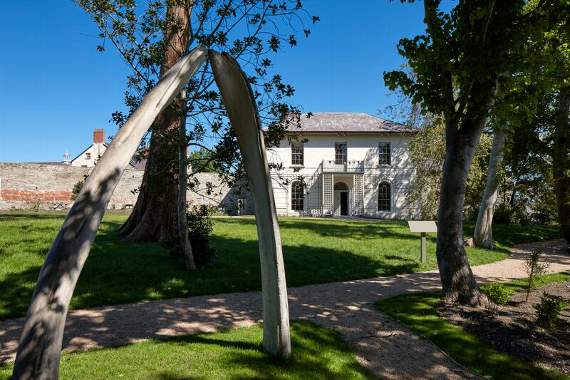
SINCE Cardigan Castle was reopened to the public in April, thousands of people have walked around the gardens and been fascinated by the restored whalebone arch in the castle grounds.
These bones were brought to Cardigan in the middle of the 19th century by a local sea captain who gave them as a wedding gift to Castle Green House.
Many have expressed an interest in their history and their origins.
The Natural History Museum in London has looked at photographs of the arch and have been able to establish that they are from a Right Whale.
.jpeg?width=209&height=140&crop=209:145,smart&quality=75)

The arch measures 2.5 metres in height and originally the bones may have been up to 5 metres in length.
These unfortunate creatures were so named as they were considered, for a number of reasons, to be the ‘right’ whales to hunt.
Firstly they were quite slow moving and could only dive for about 20 minutes which meant they had to spend considerable time on the surface before diving again. This made them very easy to follow and kill.
Secondly they were particularly well-covered with blubber, yielding much more whale oil than some of the even bigger whales.
Additionally, this also ensured that they floated after being killed making handling very much easier.
These whales actually live for 150-200 years. In 2007 one was caught with a harpoon head embedded in its neck. Markings indicated that it had been manufactured in Boston, Massachusetts, in 1890 indicating this whale had carried it for over 110 years.
Sadly they were hunted so successfully that this particular type of whale is now effectively extinct, perhaps down to a few dozen animals.
Cardigan Castle’s whalebones are one of the few remaining arches in the United Kingdom and have stood in Castle Green grounds for over 140 years.
When Cadwgan Trust started restoration of the site the whalebone arch had collapsed, with only one bone remaining complete and the other in pieces on the ground.
The complete bone was in remarkably good condition. Although it had some ancient graffiti carved into it – which you can still see today – and looked a little green with algae and lichen it was still firmly embedded into the ground.
The other bone was in several pieces on the ground and badly rotted. It was decided to conserve the one good bone and make a resin copy of its badly damaged twin. The model incorporated some of the original bone to start the shape off and give it the right texture.
The complete bone and all the broken pieces plus the new cast were transported back to the castle nestling on foam mattresses before being placed on the southern edge of the lawn overlooking the Teifi.
Comments
This article has no comments yet. Be the first to leave a comment.