
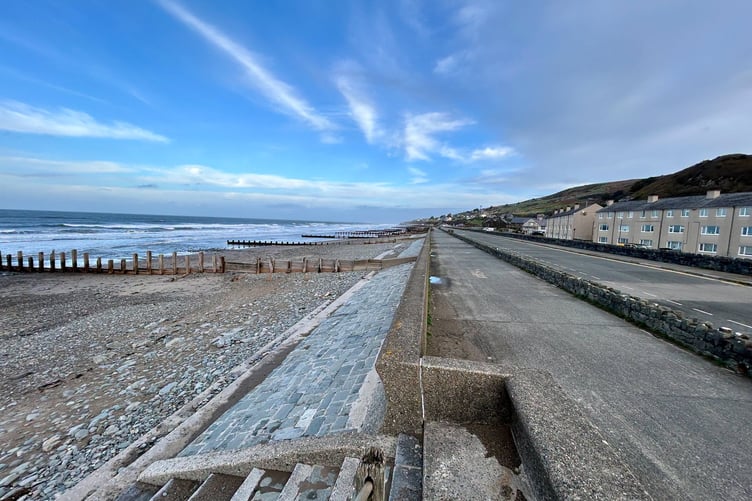
Barmouth Town Council is calling for controversial flood defence plans to be scrapped, citing concerns including public safety, visual impact, access issues, surface water, long-term maintenance.
It comes amid complaints from many that Gwynedd Council’s planning portal for people to support or object to the plans, suffered technical issues was too complicated for many to submit their opinion of the authority’s controversial North Promenade Flood Alleviation plan.
Barmouth Town Council, but councillors are “not satisfied the proposal demonstrates that it represents the most appropriate balance between flood protection, public safety, visual impact, design quality, public amenity, access, tourism, long-term maintenance and the wider interests of the community, according to their successfully submitted objection.
Their “principal concerns include the character, design quality and visual impact of the plans”.
“The proposal would introduce a substantial engineered intervention along Barmouth's North Promenade, including extensive rock armour, a secondary flood wall, flood gates, altered beach access arrangements and associated public realm works,” they add.
“Whilst the engineering function of these elements is recognised, the council considers the cumulative visual impact of the rock armour, secondary wall and associated engineering works may be greater than reflected within the submitted Landscape and Visual Impact Assessment.
“The council is particularly concerned the application provides insufficient explanation of the design rationale for the appearance of the secondary wall.
“Whilst its engineering purpose is understood, little justification is provided for the choice of finishes or for whether alternative architectural treatments were considered that could soften its appearance and better reflect the character of Barmouth.”
Town council notes “the affected frontage sits within the Abermaw Conservation Area and the Abermaw Special Landscape Area...and considers that the application does not adequately assess the impact of the proposed permanent engineered infrastructure on the character or appearance of either”.
Barmouth council remains concerned the proposal “would fundamentally alter the character and recreational value of the beach frontage.”




They also cite public safety over the proposed rock armour, and concerns “about risks associated with slips, falls, entrapment, algae growth, litter accumulation and the practical use of access points throughout the lifetime of the development.
“Given the scale of the proposed rock armour and the popularity of the beach, council considers these matters require greater confidence than is provided by the submitted application.
“The proposal differs significantly in its scale, extent of rock armour, wall design and public realm works from the earlier concepts considered during option appraisal.
“The council is not satisfied the application adequately demonstrates why the final submitted design remains the most appropriate option when assessed against its visual, amenity and community impacts.”
Surface water and residual flood risk is also raised by Barmouth, who say it is hard to understand “how the completed scheme will interact with existing surface water drainage, tide-locking, heavy rainfall events and flood pathways behind the proposed defences”, adding it is not clear who will be responsible for long-term maintenance responsibilities and funding arrangements for the proposed rock armour, drainage infrastructure, flood gates, beach access points, planting and public realm features, and algae, litter, drainage openings and access routes will be fundamental to both public safety and the appearance of the scheme.
Barmouth is also concerned about public access along and from the promenade, including beach access and routes along the Wales Coast Path.
They say they have “identified inconsistencies between elements of the submitted reports and drawings and remain unclear on aspects of the detailed design forming part of the planning application”.
The proposal to permanently removal existing timber groynes along the northern beach frontage also concerns them.
“Council recognises that, with the proposed rock revetment in place, retention of the groynes would create foreseeable entrapment hazards between the groynes and the rock, and that removal of the groynes is therefore an inevitable consequence of the design choice that has been made. The concern the council wishes to raise is with the process of decision-making that has led to that design choice. The groynes have been progressively neglected over approximately five decades on the stated basis they were ineffective at retaining beach levels. However, the applicant has now acknowledged in its published response to consultation feedback that the lowering of the beach north of the promenade is attributable to wave reflection from the existing concrete sea wall, and not to any ineffectiveness of the groynes.
“The rationale that supported the long-term absence of maintenance of the groynes is therefore no longer supportable on the applicant's own evidence.
“Council is not satisfied the application adequately considers what function properly maintained groynes could have performed, nor whether an alternative scheme that retained or reinstated a maintained groyne system alongside softer defence measures would have avoided the necessity of the extensive rock revetment proposed.
“A decision to adopt a scheme whose design requires the removal of groynes should, in the council's view, rest on a demonstration that the chosen approach is materially superior to alternatives that would have preserved them.”
Another point Barmouth makes refers to consistency with the Shoreline Management Plan and Local Development Plan Policy Area.
“Council notes the application requires a Major Policy Change to the West of Wales Shoreline Management Plan 2, since the currently adopted policy for Barmouth North at epoch 2 is Managed Realignment,” they say.
“The Major Change process is being progressed through the West Wales Coastal Group but has not yet been endorsed by Welsh Ministers.
“Gwynedd's Joint Local Development Plan Policy Area 1 (Coastal Change Management Area) requires proposals for new or replacement coastal defence schemes to be consistent with the management approach set out in the Shoreline Management Plan and to demonstrate there will be no material adverse impact on the environment.
“Council is not satisfied the application demonstrates satisfaction of the first limb of that test.”
Barmouth councillors support “the objective of improving flood resilience for the town”, but remain “unconvinced” by this application.
“For these reasons, Barmouth Town Council objects to Planning Application C26/0342/00/LL,” they conclude.
“Should the Local Planning Authority not be minded to refuse the application, the council respectfully requests these matters are fully considered before any decision is made and any permission granted is subject to robust conditions securing design quality, public access, public safety and long-term maintenance.
“The council also asks the Local Planning Authority to recognise this proposal has generated significant public concern. The breadth of concern expressed by residents, businesses and other stakeholders underlines the importance of ensuring the final scheme is demonstrably the most appropriate solution for Barmouth and the reasons for that conclusion are clearly evidenced.”
Residents had until 5 July to submit their thoughts on the application, but issues with Gwynedd’s planning portal meant many could not respond. These issues were reported and Gwynedd Council says there is still time to share your thoughts.
A council spokesperson said: “Cyngor Gwynedd Local Planning Authority is aware that recently there has been some difficulties in providing comments on planning applications online, and in particular application C26/0342/00/LL Cei Y Gogledd, i'r Gogledd o Ffordd Yr Ysgol Promenade, Abermaw. The matter is being looked into.
“The 21 day consultation period is a statutory period during which comments can be made on any planning application. This period is a minimum; and whilst we encourage anyone who wishes to comment to do so within this period, the Local Planning Authority will continue to accept comments made until applications are determined.
“Those wishing to submit comments on planning applications are reminded that they can also do so in writing to the Planning Service, Council Offices, Ffordd y Cob, Pwllheli, Gwynedd LL53 5AA or e-mail [email protected]. They should ensure that the relevant planning application number is provided clearly on all correspondence.”
Comments
We've recently changed our login process. If you have an account for commenting, you will need to re-register on the login window.
This article has no comments yet. Be the first to leave a comment.