

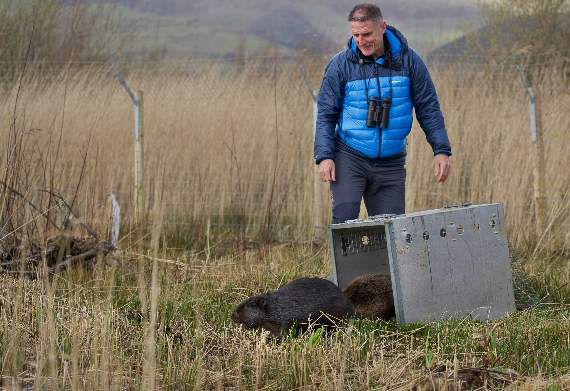
BEAVERS have been released into an enclosure on the Dyfi estuary.
Television presenter and naturalist, Iolo Williams, was on hand at Cors Dyfi Nature Reserve on Friday as a father and son beaver pair were released into an enclosure on the banks of the Dyfi.
After many months of planning and discussions Montgomeryshire Wildlife Trust have been granted a licence by Natural Resources Wales to release Eurasian beavers into the lowland peat bog which used to be a conifer plantation.
Due to the difficult residual terrain of former forestry ditches and tree stumps, managing areas of the reserve using traditional methods, such as coppicing by hand, is all-but impossible.

Over the years, Montgomeryshire Wildlife Trust have therefore been considering a range of alternative management options, including water buffalo. In more recent years, beavers – often referred to as ‘ecosystem engineers’ and well known for their amazing ability to manage wetland habitats – have come to the fore as an ideal solution.
Beavers are large, semi-aquatic rodents that live within wetland and river habitats.
They are herbivores and feed on a wide range of plant species and through their foraging, burrowing and damming activities, they can restore wetland areas, which benefit many other species, so increasing biodiversity.
Emyr Evans, from Montgomeryshire Wildlife Trust: “The beavers will be a fantastic tool in our efforts to return Cors Dyfi into a wet lowland peat bog once again. Our volunteers are really excited to have beavers at the reserve and it will be their job to monitor the beavers and measure the positive impacts of these mammals.”
On Friday, the first part of a family group, a father and son, arrived and were released by Iolo Williams, Naturalist and Television Presenter, into a secure enclosure that has been purpose built on the reserve.
Iolo Williams said: “It was a real honour to be asked to help release the beavers at Cors Dyfi. “Finally, after more than 4 centuries, these wonderful animals are back where they belong and I’m sure they will prove to be as big an attraction as their osprey neighbours.”
This family is quite special, as the father is a much rarer, black morph individual, with entirely black fur, his son has a brown pelt with patches of darker fur that can be seen in certain light. The mother will follow soon and re-join her family in a few weeks.
For the last two years, the Welsh Beaver Project, led by North Wales Wildlife Trust on behalf of all the Wildlife Trusts in Wales, have been assisting Montgomeryshire Wildlife Trust with their plans by applying for a licence to release beavers on site and funding an enclosure. A public consultation was held by Natural Resources Wales (NRW) last autumn and a licence was issued earlier this month.
The beavers for the enclosure have been sourced from Scotland, under licence from NatureScot.
This project has received funding through the Welsh Government Rural Communities - Rural Development Programme 2014-2020, which is funded by the European Agricultural Fund for Rural Development and the Welsh Government.
Although not a reintroduction to the wild, having beavers at a visitor hub like Cors Dyfi will help to inform people about their behaviour and how their natural activity can actively support ecosystem restoration.
The beavers and habitat will be regularly monitored by Wildlife Trust staff and volunteers.
The Welsh Beaver Project has been investigating the feasibility of reintroducing Eurasian beaver into the wild since 2005.
Proposals are currently being developed and in due course there will be another, separate public consultation led by NRW for the reintroduction of beavers into the wild.
Alicia Leow-Dyke, Welsh Beaver Project Officer, Wildlife Trusts Wales said: “It is wonderful to finally see beavers at Cors Dyfi nature reserve, where people can visit and learn more about the many benefits beavers can bring. We hope this will help bolster support for a managed reintroduction to the wild in the near future.”
Comments
This article has no comments yet. Be the first to leave a comment.