
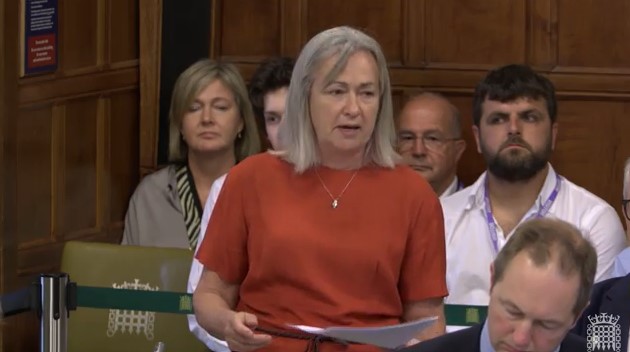
Gwynedd’s Coastguard Rescue Officers are dismayed by the way they are being treated over pay, says Dwyfor Meirionnydd MP, Liz Saville Roberts.
Mrs Roberts says she has been contacted by officers from Gwynedd, voicing deep concern and dismay at plans by the Maritime & Coastguard Agency (MCA) to remove pay for Coastguard Rescue Officers, and the detrimental effect this could have on coastal communities.
During a debate on the issue, the MP highlighted the vital role coastguard officers play in Gwynedd, and called on UK Government and the MCA to urgently reconsider their approach.
The proposed changes would see Coastguard Rescue Officers no longer receive hourly payments for attending emergencies, with the MCA moving to a revised model following a recent legal ruling.
Mrs Saville Roberts emphasised the importance of the service in Dwyfor Meirionnydd, which has seven coastguard stations and around 80 dedicated Coastguard Rescue Officers.
She said: “The Maritime and Coastguard Agency’s decision to remove hourly remuneration for Coastguard Rescue Officers and implement a volunteer model has caused real anger and anxiety.
“North Wales and much of mid Wales are in Coastguard Area 14, which stretches along the north Wales coast from Flint, round Ynys Môn, and Gwynedd, and down to New Quay in Ceredigion.
“Gwynedd has several coastguard stations, including Aberdaron, Abersoch, Bangor, Barmouth, Criccieth, Llandwrog, Porthdinllaen, and Tywyn. At least 80 volunteer rescue officers are based here.
“These Coastguard Rescue Teams provide essential emergency response capability across the Welsh coastline, including search & rescue, missing-person operations, flood response, and mud rescues.



“They co-ordinate with North Wales Police and Transport Police, North Wales Fire & Rescue and Welsh Ambulance Service, and with volunteers from the RNLI, and mountain and cave rescue teams.
“Starting from the obvious evidence that we need CROs, let me pass on what they’ve told me about the proposed changes:
“Teams will be put under extra pressure when - not if – some members can’t attend incidents because they’ll be out of pocket.
“We risk losing officers with decades of experience, skills, and local knowledge; emergency response times will increase when neighbouring teams are called in because local officers are not available.
“Recruitment will be hit as new team members are required to do 10 days’ training without remuneration.
“This will reduce the pool of people who can afford to do this, and morale will fall even further. CROs already feel isolated and ignored.”
“One CRO said people sacrifice time that could be spent with family to go out in all weather, day or night, to carry out all manner of rescues, from a dog on a cliff to recovering dead bodies.
“I have already asked the UK Government whether it has assessed how many CROs are likely to leave the service if these proposals are implemented.
“What will be the impact on public safety, and the long-term sustainability of the coastguard if it were to operate on a wholly volunteer model?
“The Government were unable to provide me with answers to these questions. I therefore asked them again of the Minister - our coastal communities deserve answers.”
Comments
We've recently changed our login process. If you have an account for commenting, you will need to re-register on the login window.
This article has no comments yet. Be the first to leave a comment.