

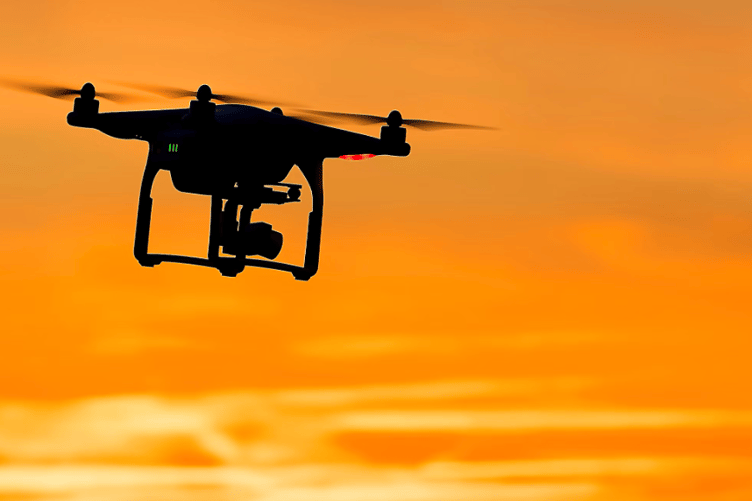
Ceredigion County Council have been told by residents that they don’t trust the authority not to misuse its plans to use drones to crack down on anti-social behaviour amid concerns over the council’s “lack of transparency”, “past behaviour”, and “inability to manage the technology responsibly.”
The council launched a consultation in December after the Cambrian News revealed that the council was looking at putting eyes in the skies to “conduct randomised, overt, high-visibility aerial patrols over designated anti-social behaviour hotspots.”
A report put before members of the council’s Corporate Resources Overview & Scrutiny Committee on 11 November said that “Ceredigion County Council seeks to adopt UAV technology to support a range of local authority monitoring and official inspection functions, the primary focus being on tackling Anti-Social Behaviour.”
“With an emphasis on investigation and deterrence this includes, but is not limited to, conducting randomised, overt, high-visibility aerial patrols over designated antisocial behaviour hotspots, accompanied by prominent public signage to ensure transparency and awareness of monitoring and enforcement operations, and overt collection of evidence to support investigative and enforcement actions,” the report said.

The report added that drone technology could also be used to monitor health and trading standards, pollution incidents, abandoned dogs, and fly-tipping.
As well as enforcement, the drones could also be used for building inspections, planning developments, surveying, traffic monitoring, and parking enforcement.
In a fresh report to be put before the Corporate Resources Overview and Scrutiny Committee on 9 June on the outcome of the consultation said that 185 of the 243 responses received raised concerns over invasion privacy, including fear of being watched, filmed at home, surveillance creep, ‘Big Brother’, spying, and misuse of footage.
Responses also raised ‘authoritarianism concerns’ as well as saying the plan is a “waste of money”.
130 responses cited a “lack of trust in the council”, and raised concerns about “misuse, lack of transparency, past behaviour, or inability to manage the technology responsibly.”
Residents also called for “independent oversight” of the plan, with “clear limits” set on its use.
Concerns were also raised over the drone’s effect on livestock and wildlife, but support was given for the use of drones on issues including fly-tipping and animal welfare.
The council report said that the council secured funding from the Office of the Police and Crime Commissioner (OPCC) via the Home Office’s Anti-Social Behaviour Hotspot Response Fund in August last year.
“The funding supports the Council’s strategy to enhance anti-social behaviour enforcement through the use of modern technology,” the report said.
The report to be put before the committee on 10 June says that the draft policy has been tweaked in light of the consultation responses, but the council is likely to push ahead with its plans.
The report says the policy “aims to ensure that UAV technology is utilised in a lawful, ethical, and effective manner.”
The draft policy says that all drone operations will be ‘overt’, with annual reports of drone usage available to the public via the Council website.
Comments
We've recently changed our login process. If you have an account for commenting, you will need to re-register on the login window.
This article has no comments yet. Be the first to leave a comment.