

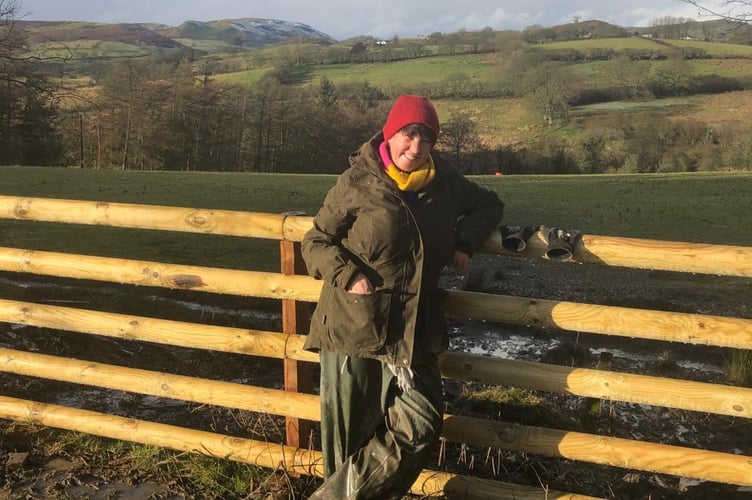
A High Court judge said a company which wants to build new electricity lines in Wales didn’t comply with a code of practice regarding a notice it issued to a farmer about surveying her land.
Mr Justice Kimblin said Green GEN Cymru Ltd’s notice to Natalie Barstow, of Powys, was “unduly broad and lacking in particularity”.
He described the document as “a pro-forma notice which failed to either have regard to the circumstances which were relevant to the land or to the owners and the occupiers”. The code of practice relates to powers of entry.
The notice was issued in August 2024 – nearly a year before footage from wildlife cameras showed surveyors entering a brook at Mrs Barstow’s farm in Powys. The footage was identified after Mrs Barstow said she’d been advised the survey had been deferred.
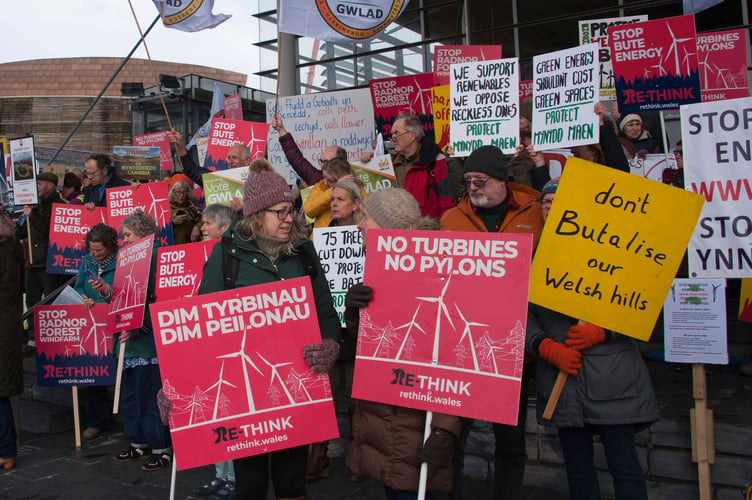
Three claimants including Mrs Barstow had accused defendant Green GEN Cymru of an “unlawful” abuse of power to “force” access onto private land. Court documents alleged agents acting on behalf of the company behaved in a careless manner “without regard for environmental protections or community wellbeing”.
It was alleged agents crossed farm boundaries in dirty clothes, risking the spread of livestock diseases such as bovine tuberculosis or sheep scab, and not agreeing to biosecurity and environmental protocols.
Green GEN Cymru denied the allegations and argued Mrs Barstow and fellow claimants the Campaign for the Protection of Rural Wales and the Land Justice Coalition Ltd wanted to stop the pylon line projects.
The company, which wants to build three power lines in mid and west Wales to connect planned wind farms to the wider grid network, alleged the claimants’ “principal objective is delaying the projects in the hope that they may go away altogether”.
Proposals affect parts of Carmarthenshire, Ceredigion and Powys - with one of the routes stretching across the Welsh border into Shropshire.




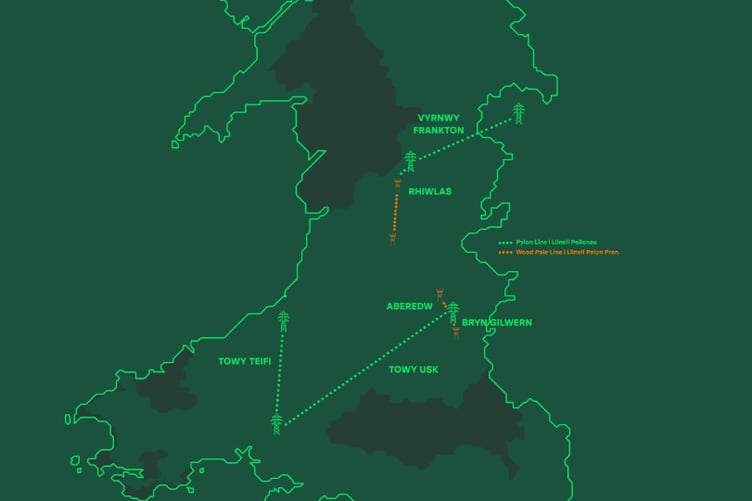
Green GEN Cymru said the importance of new grid infrastructure to connect renewable energy schemes to where that electricity was needed “cannot be overstated”.
At a hearing in April barrister Sian McGibbon, on behalf of lead claimant Mrs Barstow, said wildlife camera video evidence emerged of surveyors entering a brook at her farm more than a week after she’d been advised the survey had been deferred for a second time.
It was alleged those carrying out the survey were in dirty clothes and hadn’t taken adequate disinfection steps, posing a biosecurity risk, and that the whole situation had taken “a profound emotional toll” on Mrs Barstow.
Green GEN Cymru legal representatives said the two ecologists who accessed the brook for an otter survey had done so via neighbouring land where a licence was in place and understood the stream to form the boundary and therefore capable of being accessed from other land.
The Campaign for the Protection of Rural Wales and the Land Justice Coalition Ltd challenged whether the use of notices to allow access to land ahead of possible compulsory purchase orders by Green GEN Cymru was lawful. These orders allow some organisations to forcibly acquire land to make way for infrastructure projects deemed to be in the public interest.
In his judgment Mr Justice Kimblin said the ecologists who entered the Barstows’ land had done so by mistake and that the entry was “minor and inadvertent”.
He also said Mrs Barstow and husband recycled any post marked “to the occupier”, which he said was “unwise”, and she’d declined to respond to widespread requests for information by Green GEN Cymru.
There were several complaints as part of the case about biosecurity and Mr Justice Kimblin said there was evidence that Green GEN Cymru “has in some instances served notices largely with regard to its own needs and with insufficient regard to the requirement to give proper notice and to enter land at reasonable times”.
He said: “I find that the failure to grapple with the risks of transmission of bTB (bovine tuberculosis) to be the clearest example of a gap in the defendant’s insight into the justifiable needs and concerns of those whose land they would enter.”
He said biosecurity measures were initially handled through contractors used by Green GEN Cymru before the company introduced a standardised security protocol. He also said the company had improved the notices it issued.
He also said he didn’t find any public law error on the defendant’s part in respect of its duties under the 2016 Environment Wales Act and the 1981 Wildlife and Countryside Act.
Mr Justice Kimblin added the claim had been unsuccessful “in important respects” but had brought about a change in the defendants procedures and approach. Bearing everything in mind he said the claimants should recover 60% their costs, which amounts to around £21,000 alongside their own legal fees.
Mary Smith, a lawyer at New South Law, which said it acted on behalf of more than 500 local farmers, businesses, and landowners, said: “Your home is your sanctuary. That sanctuary has been disrupted over and over again by an energy company that has shown minimal regard for our clients’ welfare, the impact on their businesses and family life, and the safety of their livestock.
“It should not have taken a high court case brought by a community group and charity on behalf of hundreds of landowners and occupiers to make sure developers comply with the law. Adequate regulation should be in place to govern energy company behaviour and to protect the public.”
She said 20 people, many of whom were its clients, were summoned to court last year for refusing to provide access to their land and faced with the threat of costs if they lost.
Mary Smith added that her clients felt ‘vindicated’ by the judgement.
Green GEN Cymru said it acknowledged the court’s judgment and its decision to discharge an interim injunction restraining further entries which was granted by a previous judge.
In a statement Green GEN Cymru said the judgment provided clarity on the use of statutory survey powers under the 2016 Housing and Planning Act.
“The court acknowledged that changes have already been made to our procedures, practices, and approach and we will ensure that any further use of these powers reflects the judgment,” it said.
“Environmental and technical surveys are essential to developing major infrastructure responsibly. The use of these statutory powers has now been considered through the courts and the judgment provides a clear basis for future conduct and engagement.
“As we have consistently said our preference remains to work collaboratively with landowners and stakeholders and we will continue to prioritise dialogue, cooperation, and voluntary agreements wherever possible.
“We are committed to carrying out our work responsibly, maintaining high standards of engagement, biosecurity, and environmental care as we support the development of the infrastructure needed to deliver a secure and resilient energy network for Wales.”
Comments
We've recently changed our login process. If you have an account for commenting, you will need to re-register on the login window.
This article has no comments yet. Be the first to leave a comment.