

Health chiefs will spend two days later this month deciding whether to push ahead with plans to downgrade stroke services at Bronglais.
Following months of consultation, which has cost hundreds of thousands of pounds, the 22 members of Hywel Dda Health Board will meet on 18 and 19 February and decided whether they go ahead with plans to downgrade stroke services in Aberystwyth to a treat and transfer unit, with patients then being sent to Llanelli.
The proposal forms part of what the health board calls a Clinical Services Plan which proposes changes to critical care, dermatology, emergency general surgery, endoscopy, ophthalmology, orthopaedics, stroke, radiology and urology.
Speaking ahead of the meeting, Mark Henwood, Executive Medical Director said: “We know that these services are fragile and cannot continue as they are. Our clinical teams are spread across multiple sites and recruitment is an issue across the NHS. Our hospitals require ongoing maintenance, with some parts approaching or having reached the end of their intended lifespan. We need to make decisions on the changes needed to address these fragilities, so our services raise standards and meet the needs of our population into the future.”
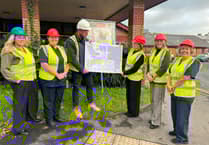
An independent consultation report prepared by Opinion Research Services (ORS) has been published on the board’s website: https://hduhb.nhs.wales/clinical-services-plan/.
The report summarises feedback from the public consultation, including more than 4,000 questionnaire responses alongside views gathered at public events, staff meetings and stakeholder sessions. Over 4,000 people also attended Health Board events and meetings during the consultation to share their views.
Campaigners against the plans claim the consultation process has cost the health board around £300,000.
Dr Neil Wooding, Chair of Hywel Dda University Health Board, said: “We have a responsibility to weigh public feedback together with clinical evidence, workforce considerations, sustainability challenges and the need for services to meet the highest possible standards. As we move into the next stage, it is vital that the decisions we make are for the benefit of all our communities across Hywel Dda and neighbouring areas.
“We must also ensure that our decisions deliver clear public value and support the best possible patient outcomes. As a Health Board, we have a statutory responsibility to provide the best possible services for our communities, and any decisions we make must support that responsibility without setting an unhelpful precedent for the future.
“These decisions will shape our services for the longer term, so it is essential that we take the time needed to reach well informed, balanced conclusions. Above all, we must ensure that the services we provide meet people’s needs, both now and into the future.”
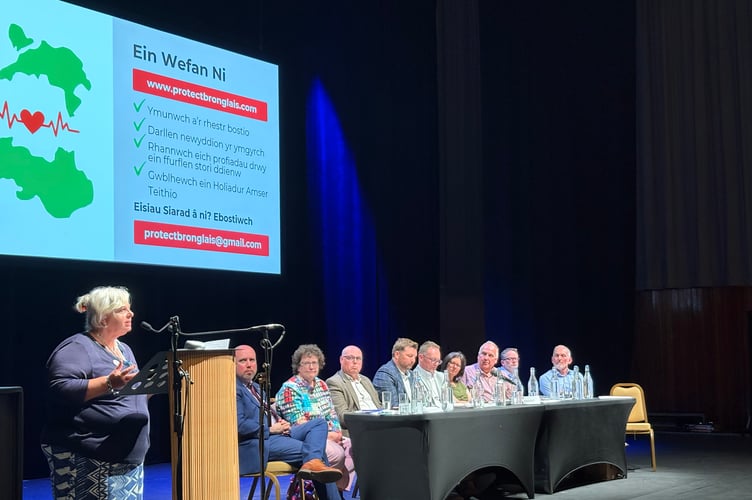
The plans have been met with ferocious opposition in mid Wales, leading to the formation of the group Protect Bronglais Services, which has attracted people from all across the region who use Bronglais Hospital, as far away as Llanidloes and Dolgellau.
"If the plans to downgrade stroke services at Bronglais are given the go ahead, its makes anything else they plan to do a lot easier.
“Recently, PBS wrote to every independent Board Member of Hywel Dda with a copy of our submission to the consultation – (just in case it hadn’t been distributed!) In so doing, we reminded them that Prince Philip Hospital, Llanelli does not have an A & E Department – this would be pivotal if Stroke Rehabilitation was to be situated at this hospital and if stroke patients transferred there from Bronglais, (or anywhere else for that matter), were to suffer any kind of post-stroke emergency such as a heart attack or an ischaemic bowel.
“It's details like this that the Health Board has failed to address in its Clinical Services Plan along with treatment for stroke patients who may be palliative – sadly one in seven people do not survive a stroke.
“We hope that the information informs the Board’s dozen independent members more fully about the possible damaging consequences of moving stroke rehabilitation services away from Bronglais Hospital, before the Board reaches its decision on the 19 February.
“As we have said many times before, the debate around this matter is not just about policy. This is about values: primarily about fairness and equity and Hywel Dda need to think very deeply about what sort of Health Board they want to be. At the end of the day, this is all about doing the right thing.”
A public meeting in the summer drew support from politicians and saw more than 400 people pack the Great Hall.
Speaking in June, Ceredigion MS Elin Jones said: “Some of you like me were out on the streets and the Senedd in 2005 when the proposal at the time for Bronglais was to downgrade A&E, emergency and maternity services.
“A long drawn out campaign followed leading ultimately to the Marcus Longley report.
“That moment felt like a line in the sand.
“A final recognition by government that an area the size of the Bronglais catchment needed a fully functioning district general hospital, planned for strategically by all three mid Wales health boards and that a hospital functioning in that way needed a particular breadth of services to attract the full compliment of staff and expertise and properly serve the local population.
“And crucially it needed to be modelled in such a way that recognised that numbers coming through the door of a rural hospital are always lower than an urban area and services needed to be designed in a more bespoke way.
“A one size fits all is not equivalent to one size suits all.
“The highly engaged and innovative staff at Bronglais have been designing those bespoke services since then.
“The stroke service at Bronglais has been particularly innovative and now all that recent progress is in jeopardy.”
Ms Jones went on to describe the treat and transfer model as being full of risk, adding: “It’s the transfer element that fills us full of dread.
“There is no detail in the consultation about transfer of stroke patients
“Without it, there is no hope that the health board can persuade this community to trust a treat and transfer model and it’s not fair for you to ask us to do so.
“All experience and evidence is that a transfer model treats us as second class citizens.”
Carmarthen West and South Pembrokeshire MS, Sam Kurtz, told the Aberystwyth crowd: “We’ve all got personal experience.
“I remember my father being in the intensive care unit at Withybush.
“The quality of care he received from those fantastic dedicated staff. But we had to take him there in our own car because no ambulance was available.
“Two weeks in intensive care, a 40 per cent survival rate. Thank god we bundled him into a car to get him in because had we waited for an ambulance, my father would not be here now.
“How can we trust the transportation links.
“Assurances are not enough when communities do not trust the health board and this direction.
“I am really frustrated because we should be immensely proud of the health board we’ve got, of the hospitals we’ve got and the staff that work within it.”
Comments
We've recently changed our login process. If you have an account for commenting, you will need to re-register on the login window.
This article has no comments yet. Be the first to leave a comment.