

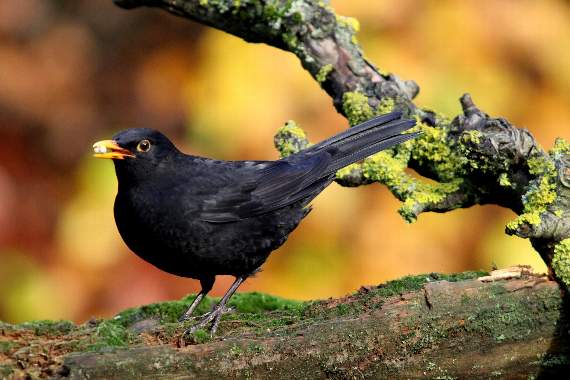
RECENTLY I looked on as a blackbird went about constructing its nest, writes Roy Bamford.
I had been thinking for a few weeks that perhaps there was a nest on the go, but is wasn’t until mid March that things really began to move.
At first there were just a few wispy bits of moss, added to very gradually over a period of some days such that after about four days, anyone could have identified a nest in the making.
Dead grasses and leaves were then woven into the moss and it really did begin to look the part.



-and-John-Bradbury-(inset).png?width=209&height=140&crop=209:145,smart&quality=75)
A thin layer of mud was then plastered all over the inner surface to substantially firm up the structure.
A song thrush would have added more mud and left it at that, laying eggs onto quite a hard surface, but a blackbird goes on to add another layer of dry grasses and leaves to give a much softer and, you might imagine, a more comfortable finish.
The nest appeared then to be abandoned for a few days before the first egg was laid.
By the end of March the female was sitting tight, incubating a clutch of four.
This nest was easy to find, in the garden, near the top of a post supporting and camouflaged by honeysuckle, a typical nest site for a blackbird though they are very catholic about where they might settle.
Inside large outbuildings, hedges, large trees, garden sheds, rock faces, even on farm machinery, you name it and chances are someone will have seen blackbirds nesting there at some time or other.
Other species are just as likely to nest in strange places, but it was quite a surprise when I found a mallard’s nest six feet above the ground in the top of quite a dense, garden hedge that I had been asked to cut.
Perhaps we ought not to be surprised so often, it seems to me that when it comes to nature and natural history we ought to expect the unexpected, at least on a fairly regular basis.
I am always expecting to find long-tailed tit (lotti) nests in blackthorn thickets near water, just because that is where I found my first ‘lotti’ nest, some 50 plus years ago.
An intricately woven structure of moss, lichen, spiders’ webs, wool, feathers and hair they are about the size of your average Easter egg – maybe a bit smaller – with an entrance hole towards the top.
The spider webs and moss give the whole structure a flexibility that comes in useful once the eggs hatch and anything from eight to 12 young long-tailed tits begin growing.
The books say that typically a lotti nest will be within a metre or two of the ground, exactly where I found my most recent one, within the same hedge as that mallard.
But three years ago, while surveying in some mature broadleaved woodland, I watched a lotti carrying nest material high in the canopy and was able to follow its progress and see that it had a nest at least 50 feet up, on a large oak.
The nest was right by the trunk of the tree, supported by a substantial branch.
Through binoculars I could make out a superbly camouflaged, mossy nest and watched it bulge and distort as the bird adjusted things inside.
Long-tailed tits are amongst the earliest of nesters and by the end of April or early in May the first broods will be out.
Early nesting has stood them in good stead these last few years and they are probably at a long-term high as far as population goes.
Cold, harsh winters may have taken a heavy toll in the past, but we have not seen one of them for a while.
In addition, although they are recognised as insect feeders, some long-tailed tits have taken to coming to bird tables or feeders and along with many other species, they have benefitted from that extra food, provided to tide them over the leaner winter months.
I fully expect the blackbird to be hatched and have young very soon, and all being well, there will be a second brood in May and maybe even a third to come after that.
However, the long-tailed tit will usually put all their efforts into just the one breeding attempt.
Comments
This article has no comments yet. Be the first to leave a comment.