
On 1 March 1918, the steamship Penvearn was making her way from Barrow-in-Furness towards Barry Roads when she was torpedoed off the Welsh coast, somewhere near South Stack, Anglesey.
For Borth, the name of that ship would soon mean something very different.
Several local men were serving aboard her, and three of them would never return home.
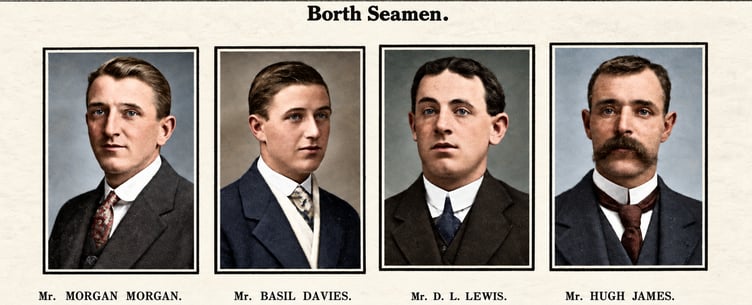
Hugh James, the ship’s boatswain, was 37 and lived at Manchester House in Borth with his wife, Mary Jane. Morgan Morgans, 29, was the son of David and Mary Morgans of Gogerddan House, Ynyslas. The youngest was Basil Lougher Davies, the son of Captain Thomas Davies of Gloucester House. Basil was only 20.
Borth was a small community, with a population of around a thousand. These were not simply names appearing in a newspaper casualty list. They were husbands, sons and neighbours, members of families who had lived with the sea for generations. In a village where so many men earned their living aboard ship, their loss would have been felt far beyond their own homes.
The deaths aboard Penvearn were not confined to Borth, and some of those lost were barely more than boys.
Among the crew was Albert Roberts, a mess-room steward aged just 14. Harold Jenkins, a cabin boy, was 15, while Herbert Henry Taylor, an apprentice, was only 17. There were older and more experienced seamen aboard too, but the ages of these boys are a stark reminder of just how young some merchant sailors were when they were sent out into waters where enemy submarines were waiting.
One man from Borth did survive.
David Llewelyn Lewis of Dalston House escaped the sinking, but what followed was an ordeal in itself. He ended up with a group of men clinging to an overturned boat through the night. A contemporary Cambrian News report later said that David was one of only three men eventually picked up after spending almost the whole night there.
Eight of their shipmates died from exposure before help arrived.
It is difficult now to imagine those hours - the darkness, the cold, the exhaustion and the uncertainty of whether anyone would find them in time. Men around David were dying, one by one, while those still alive held on and waited.
David did survive, and he came home to Borth.
For a while, his was the one story from Penvearn that seemed to have ended differently.
When the Cambrian News later printed the faces of four Borth seamen together, Hugh James, Basil Davies and Morgan Morgans were already dead. David appeared beside them because he had survived.
But his story did not end there.
After recovering, David returned to merchant service. Seven months later, in October 1918, he was serving aboard the SS Heathpark when that ship too was torpedoed.
He was 26 years old.
And this time, David did not come home.
For a village the size of Borth, losses like these would have been impossible to contain within a handful of families. The telegrams may have arrived at individual doors, but the grief would have spread through the whole community. These were familiar names and familiar faces, men people had grown up with, worked alongside or passed in the street.
Borth had already lost Hugh James, Basil Davies and Morgan Morgans when Penvearn was torpedoed.
David Lewis had somehow made it back.
For a little while, that must have felt like one small piece of good news in a year that had brought so much sorrow.
Seven months later, another torpedo found his ship.
And this time, David did not come home.
Comments
We've recently changed our login process. If you have an account for commenting, you will need to re-register on the login window.
This article has no comments yet. Be the first to leave a comment.