
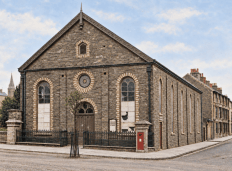
For almost thirty years, the Temperance Hall stood at the corner of North Parade and Queen’s Road. It was not an especially grand building, but it became one of those places that seemed to find its way into all sorts of town life.
It had been built in the 1860s, at a time when the temperance movement was gathering real strength across Wales. One of the men behind the movement in Aberystwyth was the Rev. John Williams. He had visited the Great Exhibition in London in 1851 and came home impressed by the Band of Hope movement. By the following year a branch had been formed in Aberystwyth, encouraging both children and adults to promise that they would abstain from alcohol.
The new Temperance Hall gave the movement somewhere of its own, but it soon became useful for much more than that. Meetings were held there, along with lectures, concerts and other public gatherings. There were galleries inside and space for a sizeable audience, so for a time it became one of the better-known halls in the town.
Its place in Welsh musical history came almost by accident.
On 21 May 1878, Joseph Parry’s *Blodwen* was given its first public performance there. Parry was then Professor of Music at the University College of Wales in Aberystwyth and conducted the performance himself. *Blodwen* would later be remembered as the first Welsh-language opera, but that evening it was simply a new work being heard by an Aberystwyth audience for the first time.
When *Blodwen* was performed again at the Temperance Hall in March 1881, so many people turned up that some could not get in. Another performance was arranged within days. The advertisement made the most of it, announcing an “IMMENSE SUCCESS” and telling people to “COME EARLY”. Tickets cost two shillings for the floor and one shilling for the gallery, with schoolchildren admitted for half price.
Less than a year later, however, the hall was making the news for a very different reason.
In February 1882, the Borough Surveyor examined the building and gave an unfavourable report to the Town Council. John Williams then had four other men inspect it. What followed was reported in a wonderfully matter-of-fact way. One of the men died before he could submit his findings, another had not yet reported, while the remaining two considered there to be “no immediate danger”.
Only the previous year the hall had been packed with people trying to hear *Blodwen*. Now the condition of the building itself was being questioned.



Despite that, it carried on for another thirteen years. In its later days the building was used by the Salvation Army, so in a way it never moved very far from the temperance ideals with which it had begun.
Then, in May 1895, the *Cambrian News* reported that the Temperance Hall was being demolished. John Williams intended to build several houses on the site.
For a short while there must simply have been an empty space at the corner of North Parade and Queen’s Road.
For nearly thirty years, though, people had climbed those steps and passed through its doors for meetings, lectures, music and public gatherings. The building disappeared, but quite a lot of Aberystwyth life had happened inside it.
Comments
We've recently changed our login process. If you have an account for commenting, you will need to re-register on the login window.
This article has no comments yet. Be the first to leave a comment.