
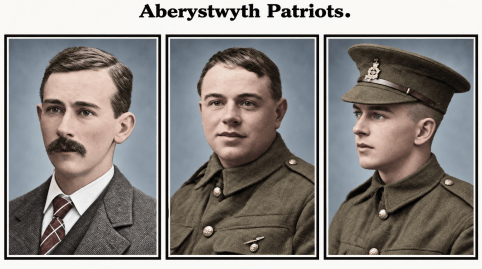
In December 1918, less than a month after the end of the First World War, the Cambrian News published three portraits under the heading ‘Aberystwyth Patriots’. They showed a father and his two sons, all from the same family in Trefechan. By the time the photographs appeared, all three were dead.
At 3 Spring Gardens lived Mary Elizabeth Stephens, her husband William Owen Stephens and their children. In a little over three years, Mary Elizabeth had lost her husband and two of her sons to the war.
William had served in the Militia and the Navy before the war. In March 1915, he joined the Cardigan Battery of the Royal Field Artillery and went to Cardiff for training. Within days he became seriously ill with fever. He died on 14 March, having barely begun his military service, and was buried with full military honours in Cardiff.

Back in Trefechan, Mary Elizabeth was left to carry on without him. But the war was far from finished with her family.
Her son William Thomas, known as Willie, had worked at the National Library of Wales in Aberystwyth before enlisting in the South Wales Borderers. He went to France in 1916 and served with the 2nd Battalion, which had already suffered heavy losses on the Somme.
By August 1917, his battalion was fighting around Ypres in Belgium. On 16 August, during the Battle of Langemarck, Willie was killed in action. He was just twenty years old.
His body was never identified. Today, his name appears on the Tyne Cot Memorial in Belgium, alongside thousands of other men who have no known grave. Mary Elizabeth had lost another member of her family, and this time there was no grave where she could visit her son.
Her other son, James, known as Jimmy, had enlisted in the Royal Army Medical Corps in September 1916. He was sent to France on 4 April 1918, joining the 58th Field Ambulance. His duties included carrying wounded soldiers from the battlefield to receive medical attention.
He had been in France for only fourteen days when, on the morning of 18 April, he was killed.

A fellow member of his unit, Arthur Linfoot, recorded the day's events in his diary. He wrote that two men had been wounded and “a new man called Stephens killed first thing in the morning.”
It was just a few words in a soldier's diary, written by a man who had already seen so much death. The new man was Jimmy Stephens of Aberystwyth, whose mother had already lost her husband and another son.
When the news reached home, a memorial service was held for Jimmy in Aberystwyth. Contemporary newspaper reports recorded the terrible circumstances of his mother, who had now lost her husband and two sons in the war.
Jimmy was buried at Lijssenthoek Military Cemetery in Belgium. Willie had no known grave, while their father lay buried in Cardiff. Three members of the same family, buried or remembered in three different places.
The war finally ended on 11 November 1918. Across Britain, families welcomed home the men who had survived.
In December, the Cambrian News brought William, Willie and Jimmy Stephens together again, their faces appearing side by side in the same newspaper.
For Mary Elizabeth Stephens, at 3 Spring Gardens in Trefechan, that was the only way she would ever see her husband and those two sons together again.
Er cof am William Owen Stephens a'i ddau fab, Willie a Jimmy. Ni chânt eu hanghofio.
In memory of William Owen Stephens and his two sons, Willie and Jimmy. They will not be forgotten.
Comments
We've recently changed our login process. If you have an account for commenting, you will need to re-register on the login window.
This article has no comments yet. Be the first to leave a comment.