

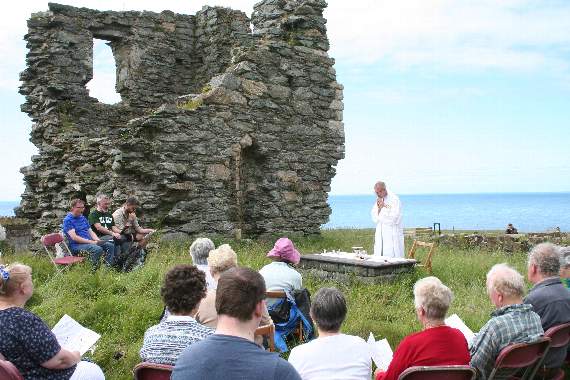
A PILGRIMAGE has been held to mark the 1,500th birthday of the abbey on Bardsey Island.
The Island has been noted as a place of pilgrimage since the early years of Christianity, but there are signs of settlements on the island that date from earlier periods.
It became a focal point for the Celtic Christian Church, attracting devout monks, and it is believed that St Cadfan began building a monastery on the island in the sixth century.
The Abbey ruins that are preserved today are the 13th century Augustinian Abbey of St Mary’s which was in use until the dissolution of the monasteries in 1537 after which Bardsey was left to the pirates and marauders until the establishment of a farming and fishing community in the mid-18th century.
The well-known reference to the island as the burial place of 20,000 saints dates from the early middle ages, when three pilgrimages to Bardsey were said to equal one to Rome.
Sue Roberts, co-ordinator of the Cylch Catholig, a society for Welsh speaking Catholics, said: “This was a wonderful excuse for a celebration and what better way to celebrate than with a pilgrimage!”
The ecumenical pilgrimage started at Llyn’s best kept secret, Felin Uchaf, an eco-centre, nestling in tall grassland and trees not far from Rhoshirwaun.
It was there Canon Andrew Jones, the vicar of Llanbedrog, told the story of how Cadfan came to Bardsey.
He spoke of how Cadfan’s ancestors were part of the British diaspora who, a century or two before, had settled in Brittany.
He then returned to Tywyn where he could see Bardsey Island across the bay and it was there he eventually settled.
In the middle ages, St Hywyn’s Church in Aberdaron was also built originally as a Catholic church.
For only the second time since the Reformation in 1536 the pilgrimage celebrated a Catholic Mass there, led by Fr Allan R Jones, a Welsh-speaking Catholic priest from Maesteg.
See the full story in this week’s Arfon/Dwyfor edition of the Cambrian News
Comments
This article has no comments yet. Be the first to leave a comment.