
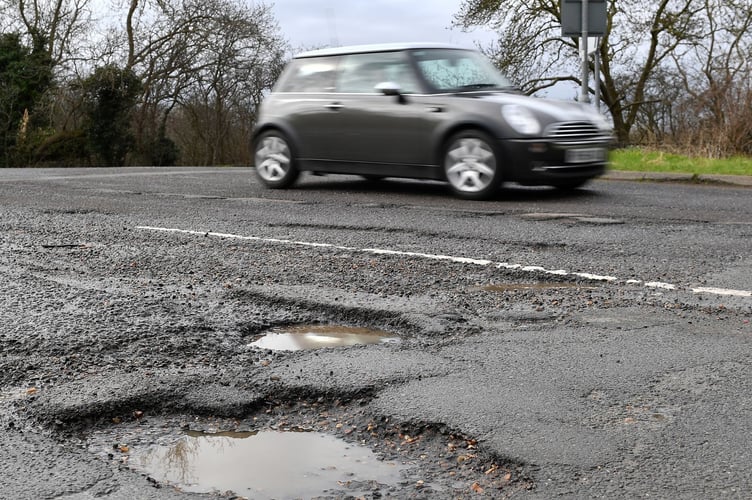
Thud. Thud. Rumble. Thud. Those are sounds only all too familiar to motorists in Wales as they navigate pesky potholes pitting the worst roads in the UK.
And motorists should not expect a quick fix to the condition of our roads despite reported increases in funding, says this year’s Annual Local Authority Road Maintenance (ALARM) survey report.
Significant investment in highways maintenance from both the Welsh Government, via the Local Government Borrowing Initiative (LGBI), plus local authorities’ own sources, has seen budgets increase by 35 per cent on last year. However, this has only resulted in marginal improvements in road conditions to date and vital resurfacing takes place less frequently – now reportedly once every 132 years on average.
“I think all road users would agree that the condition of our local roads has become a national disgrace,” said David Giles, Chair of the Asphalt Industry Alliance (AIA), which commissions the ALARM survey.




“We can see from tracking ALARM data over the last decade that inconsistent funding levels, coupled with the impact of frequent adverse weather events on a consistently underfunded – and increasingly fragile network – means a well maintained network still lies a long way off.”
Highway maintenance budgets in Wales for 2025-26 are reported to have increased to an average £11.5 million per authority, with 51 per cent of that spent on the surface and structure of the road.
Welsh authorities report that this has helped the percentage of the network classified as RED – likely to require maintenance over the next 12 months – fall by 2 per cent. Nevertheless, 7 per cent of Welsh roads – equivalent to over 1,400 miles – will still need intervention over the next year to keep roads serviceable and safe.
The ALARM survey reports local road funding and conditions in England and Wales based on information provided directly by those responsible for the maintenance of the network.
Findings of ALARM 2026, which relate to the 2025/26 financial year, also show that in Wales local authorities would have needed, on average, an extra £2.4 million each last year to maintain their network to their own target conditions and prevent further decline.
The backlog of carriageway repairs in Wales is now £623.2 million. This is the amount that is reported to be required, as a one-off, for local authorities in Wales to bring the network up to their ideal conditions – £28.3 million per authority.
Funding from central sources has increased from 26 per cent of the total spent on highway maintenance (ALARM 2024/2025) to 45 per cent this year. The additional investment forms part of the Welsh Government’s LGBI.
More than 9,600 miles (48 per cent) of local roads in Wales are now reported to have less than 15 years’ structural life remaining.
Councils filled in 11,342 potholes over the last year – up 12 per cent on last year – at a cost of £8.8 million.
In Ceredigion, £1.195 million of the council’s full budget in 2025/26 went towards reactive functions including fixing potholes across the Highways Department, reports Christ Betteley.
Ceredigion council has also made use of the LGBI over the past two years, which a council report said has “allowed our resurfacing and surface dressing programmes to be increased from £2.2 million in 2024/25, to £4.9 million in 2025/26 and £4 million in 2026/27.”
The council said that the funding “has already resulted in 3,715 potholes being repaired, and a further 28,000 potholes prevented.”
New Jetpatcher machines – one of which is funded though the LGBI – repaired 8,400 potholes or defects on Ceredigion county roads in 2025.
Overall in 2025, more than 12,000 potholes or road defects were repaired in Ceredigion, figures show.
Despite the progress, the projected highway maintenance backlog across Ceredigion currently sits at £53.8 million.
The council said that while “the level of LGBI funding is obviously welcomed”, “investment of this nature needs to be continuous/ongoing if the council is to make significant inroads into its highway maintenance backlog.”
Ceredigion County Council’s Highway Asset Management Plan for 2025-2030 says that annual funding of £4.6 million will “need to be invested in planned refurbishment by surface dressing across approximately 90km of carriageway and resurfacing across approximately 20km of carriageway” simply to “maintain the current condition”.
The plan also says funding of £2.3 million “will need to be allocated for the reactive repair of carriageways.”
The council sets a target of repairing “critical” potholes and road defects which pose immediate danger on main roads within two hours.
Safety defects “that pose an imminent risk of injury to users” on main roads are targeted to be fixed by the end of the following day after being reported, while those on minor roads are aimed to be fixed within five days.
Maintenance defects “that pose a lesser danger to users” are targeted to be repaired within one month on main and secondary routes, and within three months on minor roads.
A Cyngor Gwynedd Spokesperson said: “Gwynedd’s Highways Maintenance Service continuously monitor the county's 1,790 miles of public highways and undertake safety inspections on a regular basis.
“The weather and particularly wintry conditions can lead to increased deterioration of the road surface where necessary remedial work is undertaken. This can be challenging given the budgetary constraints on local authorities, however, any necessary emergency remedial work is carried out as soon as possible.
“The council spend on average £620,000 on this type of work. This can change depending on the weather.”
“In addition to our annual maintenance budget, we have also received funding through the LGBI this year and for the next financial year. This additional funding allows us to undertake a wider programme of road surface restoration work across the county.
“This type of work – which involves resurfacing on, overlay or improving an entire section of road – is essential as it tackles the root causes of potholes in the road and helps reduce the risk of new potholes in the future.
“We will continue to carefully monitor the network and work proactively to improve the condition of the roads for the safety and wellbeing of highway users,” Gwynedd told Julie McNicholls Vale.
Commenting on the ALARM report, AA President Edmund King said: “The ALARM 2026 report starkly warns us how much more needs to be done to eradicate this plague of potholes. We have been seeing with our own eyes, and feeling with our wheels, how record wet weather linked to substandard roads has led to many local roads becoming patchwork obstacle courses.
“The AA has been called out to 4,680 pothole related incidents in Wales in January and February this year. Extra funding needs to be maintained and spent on more permanent repairs to prevent extensive vehicle damage and potentially fatal injuries to those on two wheels.”
AIA Chair David Giles added: “Welsh authorities report that they are cautiously optimistic that the increased funding available over this year and next should help them stem further decline.
“However, with an in-year shortfall of over £52 million, it’s not the silver bullet that will enable them to clear the backlog of repairs any time soon and the public is unlikely to see lasting improvements unless the additional investment is sustained over a longer period.
“And, sadly we’ve been here before in Wales as improvements in conditions achieved in the early 2010s were soon lost as incremental funding proved short-lived.”
Comments
This article has no comments yet. Be the first to leave a comment.