
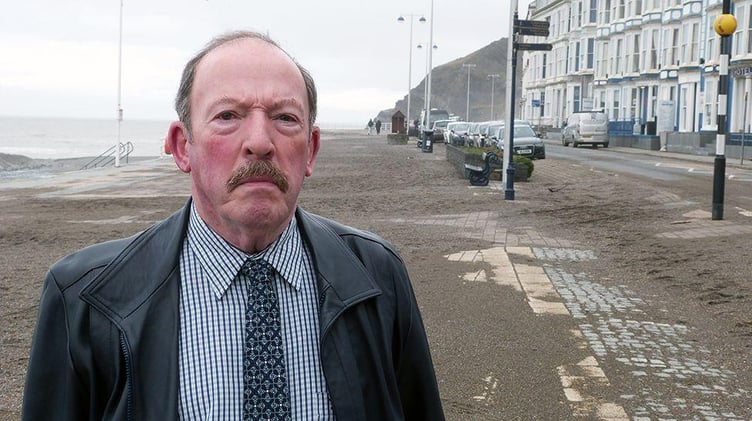
A former Ceredigion subpostmaster who lost £20,000 in the Horizon scandal says continuing delays in helping victims and their families have created a “tragedy within a tragedy”.
Alun Lloyd Jones, the former subpostmaster at Llanfarian and Blaenplwyf, has spent more than two decades fighting over the scandal which saw faulty Horizon accounting software wrongly indicate that money was missing from Post Office branch accounts.
Now, despite having finally received his own redress, Mr Lloyd Jones says his fight is far from over.
“People are saying, ‘Oh, that’s all done, finished, it’s over with’... it bloody well isn’t.
“We’re not even halfway to getting things sorted.”
Mr Lloyd Jones, a former Ceredigion county councillor of more than 30 years, was told in 2007 that almost £20,000 was missing from his branch.
He had already complained about problems with Horizon and even called in the police, believing either his premises had been broken into or money had been taken.
He says Post Office auditors initially suspended him, before reinstating him within hours, but he was nevertheless required to find the money which Horizon said was missing.
He used credit cards and remortgaged his home.
“I was quite high-profile in public life through all this, I was on the police panel, I was a school governor, I was a county councillor.




“Even if you are totally innocent, there’s still gossip and people pointing.
“When they came in, he more or less said either I had sticky fingers, or I was totally incompetent.”
In February, Cambrian News reported how Mr Lloyd Jones refused to sign Post Office accounting declarations when Horizon was showing money which, he says, simply did not exist.
“If I sign that, that is false accounting,” he recalled telling them.
“They said, ‘Well, you can’t open in the morning then’.
“I said, ‘So be it. We don’t open in the morning. I’m not signing that paper’.”
But he increasingly wants attention shifted away from what happened to him and towards the families who lived through the consequences alongside subpostmasters.
For years he has campaigned for spouses, partners and children to be recognised by the redress process, repeatedly arguing that ruined finances, reputations and health did not stop with the person whose name appeared above the Post Office door.
A Horizon Family Members Redress Scheme has now been established, with registration opening in July. It covers eligible partners, spouses, parents, siblings and children of affected postmasters, while claims are expected to begin being reviewed this autumn.
Whilst Mr Lloyd Jones welcomed the principle, what he does not welcome is the time it has taken.
In a string of letters sent this month to ministers, officials, the Post Office, Fujitsu, politicians and newspapers, he has described the continuing process as “Horizon Mark II”.
One, headed “Horizon tragedy within a tragedy”, says families are being “re-traumatised” by delays and bureaucratic demands.
Another warns that “hundreds, if not thousands of families” are still waiting for the help they need to rebuild their lives.
Speaking to Cambrian News’ Elliott Wallace, he said: “I’ve asked them to set up a dedicated team, which doesn’t exist at present, with the authority to act and target those most in need.
“I don’t think that’s unreasonable.
“I call it now a tragedy within a tragedy because of the length of time it’s taking.
“I call it Horizon Mark II.
“Much has been done, but not enough has been done.”
The scale of redress has increased substantially. Government figures show that by 28 August around £1.697 billion had been paid to more than 13,500 claimants across Horizon compensation schemes.
But for Mr Lloyd Jones, totals on a spreadsheet cannot describe what happened behind the doors of the families involved.
“Nobody thought for a second about the knock-on effect, the generational effect, if you like, on all of the families,” he said.
“They’ve been torn apart.
“There have been suicides. There have been divorces. People lost their homes.
“The whole family is suspect. ‘Oh, they’re a bunch of thieves’, and so on and so on.
“That’s the sort of life people have had to live with.”
Mr Lloyd Jones’s concerns are echoed by another former Welsh subpostmaster.
When Cambrian News spoke to Dewi Lewis after his conviction was quashed in August 2024, he said he was glad the ordeal was “over and done with”.
“No, still,” he said when asked whether the Post Office scandal had been resolved for him personally.
Mr Lewis, who ran Siop Dewi in Penrhyndeudraeth, was jailed in 2011 after Post Office auditors claimed there was a £53,000 discrepancy in his branch accounts.
His then 84-year-old father remortgaged his home to help repay the money, while Mr Lewis resigned from his senior role on Gwynedd Council.
He served four months in prison and spent a further four months wearing an electronic tag before his conviction was finally quashed in August 2024.
Mr Lewis has since received compensation, but told Cambrian News that financial redress alone cannot account for what was lost.
“The compensation was a figure picked out of the air, really, because it doesn’t make up for everything that was lost, for 15 years of a life that was lost,” he said.
His parents both died before seeing his name cleared.
“They both died while I was under that cloud,” he said.
“It was very difficult for them because my father had been a senior councillor before me and my mother worked for me in the Post Office.
“So it was very difficult for them and for my sister, who looked after the business while I was in prison.”

His then-partner Mags, whom he married shortly before receiving confirmation that his conviction had been quashed, was living in Ireland during his imprisonment.
“She flew over every two weeks from Dublin to Liverpool to visit me,” he said.
“It had quite an impact, but that wasn’t recognised at all, the impact on family and friends.”
Mr Lewis also pointed to the years of public service which were lost.
He had been a senior Gwynedd councillor with responsibility for the economy before his prosecution, while Mr Lloyd Jones served for decades on Ceredigion County Council and fellow Horizon victim Noel Thomas was an Anglesey councillor.
“We’d all been in fairly senior roles, one way or another, on county councils,” Mr Lewis said.
“Fifteen years of our life was ruined.
“And nothing about the loss to the community, or the loss of what we would have been doing publicly.”
Despite everything, Mr Lewis said Penrhyndeudraeth had remained strongly behind him, saying “the community in Penrhyndeudraeth were very supportive of me”.
He continued running the shop for another 13 years after the Post Office had claimed it was failing, eventually retiring after 45 years in business.
Mr Lloyd Jones knows similar devastating effect within his own family.
His daughter Lizzie became seriously ill while he was involved in the early campaign alongside Sir Alan Bates, forcing him to step back from the fledgling Justice for Subpostmasters Alliance.
She later died from cancer aged 40.
Repeatedly having to relive Horizon has also affected his own health.
“I’m under treatment. I’m having to go once a month to the hospital,” he said.
“It’s like a form of PTSD.
“Every time I have to regurgitate it, or like when I’m talking to you now, it brings it all back.
“I’ve suffered for 20-odd years.
“But compared to some of the others, I haven’t suffered at all.
“They’ve suffered terribly, terribly.”
The Government itself acknowledged that frustration in a letter sent to Mr Lloyd Jones on 23 September.
Kate Dearden MP, Minister of State for the Future of Work, whose brief includes the Post Office, told him she recognised both the strength of feeling in his correspondence and “the frustration and distress” continuing delays can cause.
She described Horizon as “one of the greatest miscarriages of justice in British history” and said securing redress had taken “far too long”.
The minister said the Government had inherited a redress system widely regarded as too slow, legalistic and adversarial, and said measures had since been introduced to accelerate payments.
She added that, while “significant progress” had been made, the Government recognised “there is more to do”, particularly with complex cases.
Ms Dearden also said Fujitsu had acknowledged a moral obligation to contribute towards the cost of the scandal and would consider the level of any financial offer following the Inquiry’s final report.
She added that officials continue to press the company over the issue.
Mr Lloyd Jones’s response to assurances that progress has been made is characteristically short.
“Has it?” he said.
His next ambition is to get decision makers in the same room.
Mr Lloyd Jones says he is working through the restorative justice process and aims to secure a meeting involving a senior Government official, a Fujitsu executive and someone from the Post Office with the authority to make decisions.
The Government, Post Office and Fujitsu are jointly supporting a five-year restorative justice programme which includes facilitated meetings between those affected and representatives of the organisations involved.
Cambrian News asked the Post Office to respond specifically to Mr Lloyd Jones’s concerns about delays, the impact on families and his call for senior decision-makers to meet those affected.
The Post Office did not provide a specific response, instead directing the newspaper to previously published information about the independently delivered Horizon restorative justice programme.
Post Office chief executive Neil Brocklehurst said: “During the Horizon Scandal, this organisation caused profound harm to postmasters and their families, and we must acknowledge that honestly and with humility.
“I am grateful for the Restorative Justice Council’s independence and experience as it brings us together with those who were harmed so we can work with them to move forward.
“This long-term restorative justice programme is an important part of the ongoing culture change at Post Office.”
Mr Lloyd Jones has already prepared his own briefing papers.
“I want them to come down here so I can see the whites of their eyes,” he said.
“I have got 12-odd questions and I’m dying to find out the answer to them.”
One question, however, matters to him more than most.
“You took £20,000 off me,” he said.
“Where did you put it? Where did you take that money to? What did you do?
“And if you multiply that by all those postmasters, and some of them are £50,000, one or two of them £100,000, you’re talking millions overall.
“Where does that show?”

Mr Lloyd Jones has also written to newspapers across the UK, government departments, politicians and Fujitsu itself, including correspondence sent to the company’s headquarters in Japan.
“I don’t want exclusiveness,” he said.
“I want justice.
“I want every newspaper to throw the net wider.”
For Mr Lloyd Jones, the Post Office’s recent appeal for “urgent help” to protect village branches from rising costs struck a nerve.
“It beggars belief,” he wrote.
“I have campaigned for this urgent help to help shattered families and communities begin to attempt to repair this situation over the past twenty years or so.”
Despite the anger, there is one point Mr Lloyd Jones returns to more than any other.
Time.
He says the scandal has already consumed too much of it.
“I will not give in,” he said.
“I’d rather die than give up after 20 years of fighting against a brick wall.
“How do you reason with a brick wall?
“I’d have more sense out of a brick wall. At least a brick wall wouldn’t lie to me.”
Then, for perhaps the first time in the conversation, he slows down.
“I don’t want to die without having helped hundreds and hundreds of families that have been torn apart.
“There is a storm because I can’t do, and I can’t get done, what I really feel I should be.
“I always feel I should be doing more.”
And after 20 years, his message to anyone who believes the Horizon story has reached its conclusion is simple.
“It bloody well hasn’t.”
Comments
We've recently changed our login process. If you have an account for commenting, you will need to re-register on the login window.
This article has no comments yet. Be the first to leave a comment.