

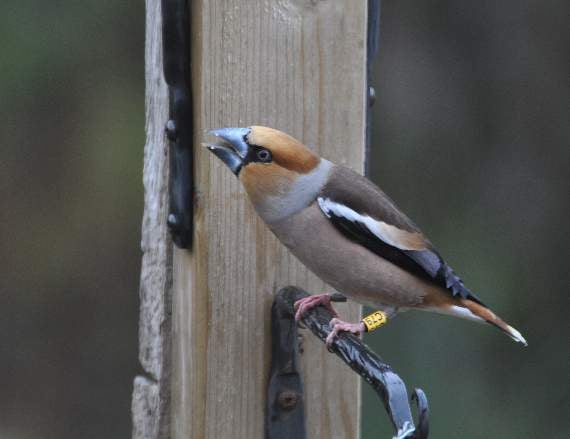
BIRD experts have called on the people of Dolgellau and surrounding areas to stop feeding a rare bird after a rise in a potentially deadly disease.
Kelvin Jones, the Wales Development Officer for the British Trust for Ornithology (BTO) has told the Cambrian News it is “vital” that “as many people as possible” stop feeding hawfinches due to a rise in Trichomoniasis – an infection which causes lesions in the throat of the infected bird, which makes it progressively harder for the bird to swallow its food, and eventually breathe.
Dolgellau is a “nationally important” area for hawfinches according to bird experts, where the population has risen. However, a current outbreak of Trichomoniasis is threatening to cull numbers.
The infection, which does not pose a threat to the health of humans, cats or dogs, is spread as birds feed one another with regurgitated food during the breeding season, and through food and drinking water contaminated with regurgitated saliva.
.jpeg?width=209&height=140&crop=209:145,smart&quality=75)



The BTO recommends to stop putting out all food and leave bird baths dry for at least three weeks to “disperse the feeding birds and reduce the contact between sick and healthy individuals” – slowing down the outbreak.
Affected birds will show signs of lethargy and fluffed up plumage, drooling saliva and regurgitated food, and Mr Jones called on those who feed birds in the garden to keep an eye out for signs.
“Hawfinches are a spectacular member of the finch family,” Mr Jones said. “For such a large chunky bird they are surprisingly shy and not the easiest to see and survey.
“Over the last 40 years there has been a major retraction in the breeding range across England and an increase in the Meirionnydd area.
“A ringing study run by volunteers from the British Trust for Ornithology, in partnership with NRW and and RSPB have shown that the Dolgellau and surrounding area has become important nationally in the numbers of both wintering and breeding birds in the area.
“Some of the Dolgellau Hawfinches are showing signs of Trichomoniasis and post mortem examination has confirmed it. It is therefore important that as many people as possible stop feeding for now.”
RSPB advice to stop the spread of Trichomoniasis and other diseases in wild, garden-fed birds include using more than one feeding site to reduce the number of birds in one place; rotating feeders around several locations to ‘rest’ each spot to prevent build up of infection on the ground underneath; cleaning and disinfecting feeders and water baths regularly, rinsing thoroughly and allowing to air dry completely; changing the water in baths frequently – ideally daily.
Comments
This article has no comments yet. Be the first to leave a comment.