
After months of preparation, the people of Penparcau have been given the chance to peer back 2,000 years, and see the uncovering of history right on their doorstep.
The Royal Commission on the Ancient and Historical Monuments of Wales (RCAHMW), - alongside the Dyfed Archaeological Trust - kicked off the event at the Hwb in Penparcau on Wednesday, with a presentation called ‘Back to the Iron Age: Exploring Pendinas’.
The talk took everyone on an 800 year journey through the time the fort was believed to be inhabited. It explored the history of excavations at the site, as well as explain the many ways the RCAHMW wants to involve the public in the project.
Dr Toby Driver began the talk with the site’s history, explaining that Pendinas was likely occupied as far back as 800BC, in the early to middle iron age - 300 years before the ancient civilisations of classical Greece, and 700 years before Cleopatra was born.
-the-UKs-leading-biennial-exhibition.png?width=209&height=140&crop=209:145,smart&quality=75)

.png?width=209&height=140&crop=209:145,smart&quality=75)

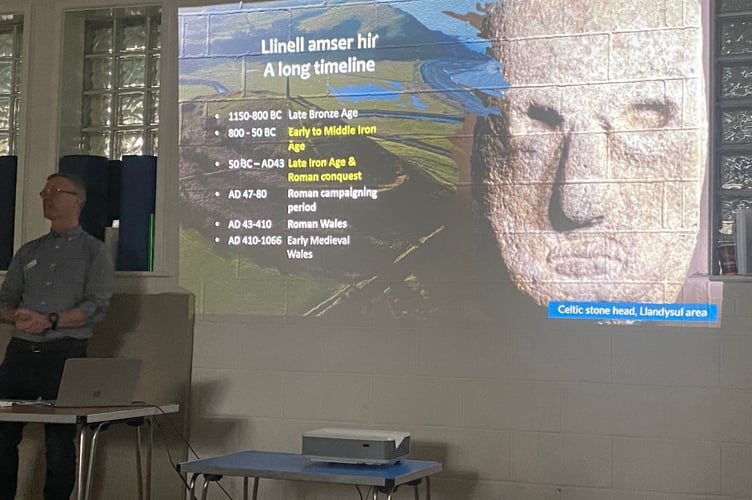
It is believed the hillfort was inhabited for almost a millennia being abandoned around the year 43AD. It is speculated that this happened during the Roman campaigning period, yet Pendinas is the only Welsh hillfort which has not uncovered any Roman artefacts.
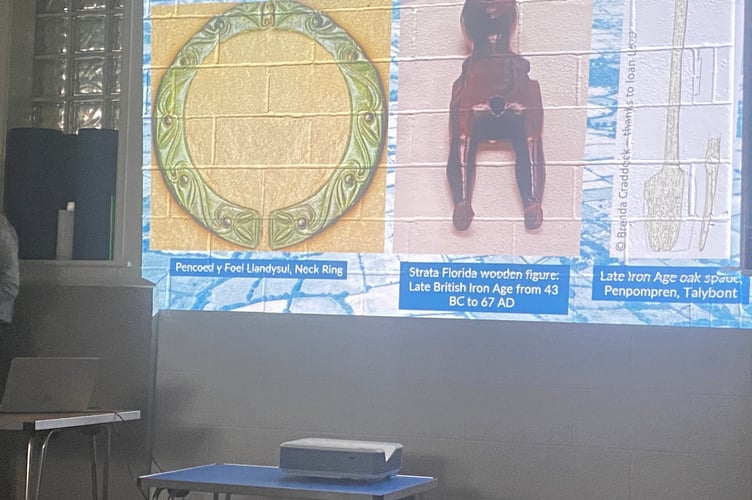
Dr Driver explored the ‘simple, but far from primitive’ lifestyle Iron age Celts lived, showing pictures of the jewellery, weapons and houses they were capable of making so long ago. Dr Driver called the fort “a major feat of engineering” as he explained that over 4,600 trees would have to be felled in order to build its multiple layers of defences, encircling the two forts on the north and south of the hill, the village, and the market centre believed to have existed there.
Someone making their way up to the hillfort 2,000 years ago would have been greeted by layers of palisade walls, lined with guards armed with slingshots - capable of fracturing a skull and killing someone from 60 metres. The guards at the gate would be armed with spears stretching over 1 metre, iron shields, helmets with a boar mount on their tops, and a short sword at their side.
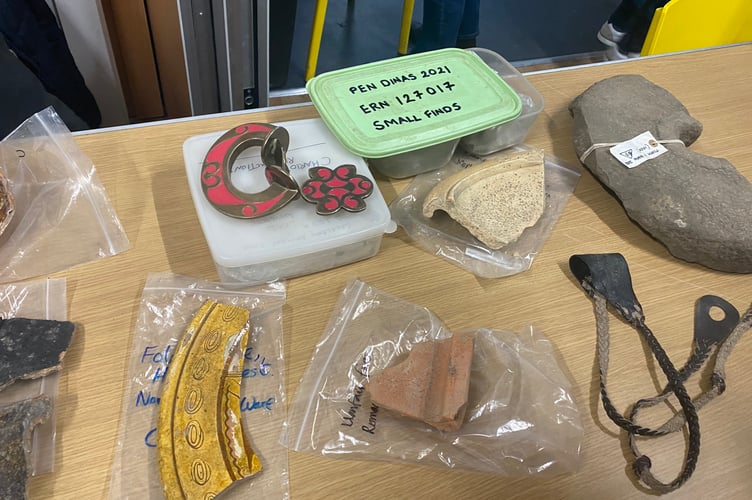
Dr Ken Murphy of the Dyfed Archaeological Trust explored the archaeology which has helped paint the picture of Pendinas’ history. Pendinas has been excavated twice in the last 100 years, once in 1934 by Professor Findle, and once in 2021. Both excavations took place around the hillfort’s South gate. Professor Findle uncovered the fort’s walls back in his excavation, and despite removing them from the site, his work allowed the 2021 excavators to discover the east side of the south gate.
As the team of excavators in 2021 - many of whom were local volunteers - continued, they uncovered evidence of housing, as well as a drainage system which functioned over 2,000 years after it was first built.
Although the artefacts uncovered in the excavation were small enough to fit within a lunchbox, their discoveries greatly enriched the idea of the site’s history. The most significant of these finds was an amber bead, which would have come from somewhere far away from Pendinas and Ceredigion. This means the site must have attracted traders from far off places, which may not surprise people who know this hillfort is biggest from Pwllheli to St David’s, and was likely a centre of commerce and trade in Iron Age Britain’s West coast. Dr Murphy described how the bead would have appeared ‘magical’ to people of the time. He said that through its ability to convey static electricity, it would be possible to ignite it by rubbing it against an object. This would be a site to see even today, but back then it was nothing less than “magical.”
The RCAHMW and Dyfed archaeological trust are returning to the site on 27 March 2023, where they will conduct a four week dig. As they did in 2021, they hope to get local people involved, and are looking for volunteers to join them in what could be the discovery of unknown ancient history, sitting right outside their houses. Anyone with an interest in ‘getting their hands dirty’ can sign up by emailing [email protected].
Debbie Stone took part in the 2021 excavation and said “The experience really took me back in time, and what we saw there changed so many of my assumptions about life 2,000 years ago. It sounds so long ago but in the grand scheme of things, it’s really not at all. I imagined them living very primitive lives, but that wasn’t the case at all. There was no better way to learn this either, than by having my hands in that very dirt, digging out history myself. I just thought ‘my God, the last person to have stood here did so over 2,000 years ago. The hardest part of the excavation was covering the site back up, not knowing if it would be seen for another thousand years.”
Ms Beca Davies, the RCAHMW’s outreach officer for the Pendinas project, wants to take the community involvement a step further than volunteering at excavations. Ms Davies wants to see guided walks, treasure hunts, mini digs and more activities taking place at the hillfort. Ms Davies said “Our main focus is you, the local community. We want you to be proud to have such a monument on your doorstep. We want the Pendinas project to leave a long lasting legacy, which stays here long after the project finishes in august 2024.”
Ms Davies is also pushing to have the site’s history brought into school curriculums.
Comments
This article has no comments yet. Be the first to leave a comment.