

IT SEEMS likely that Rhun ap Iorwerth and Keir Starmer, together with the Northern Irish and Scottish leaders, will meet in June to discuss more funding, borrowing powers for public services, railways and further devolution. Excellent.
There is every likelihood that first minister and prime minister will get on well personally. Such cohesion would of course be in Wales’s best interests. Both are people of principle and substance, serious politicians, thoughtful and humane. There is reason to be optimistic.
It’s good too to see Wales’s new first minister hit the ground running after Plaid Cymru’s solid triumph on 7 May. The hope now must be that Rhun’s demonstration of dynamism will inspire - if indeed that’s necessary - his government colleagues as a whole.
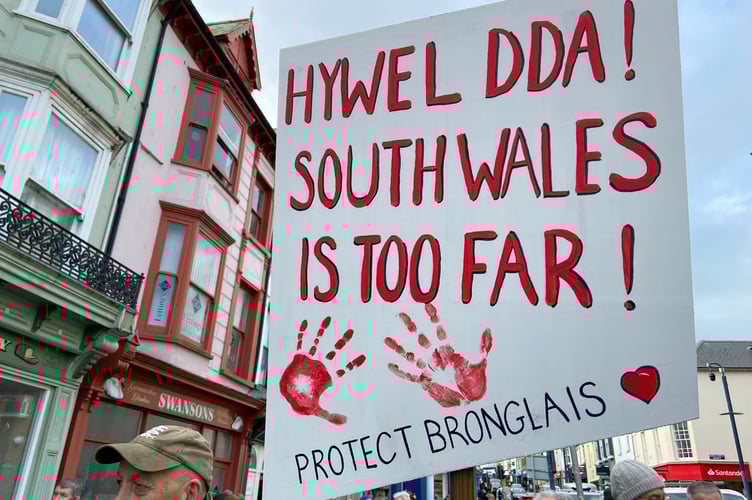
Health, in particular the pressing need for a long overdue assurance that Bronglais Hospital’s stroke unit will definitely not be downgraded, is a particular priority. Pre-election, the new health secretary, Mabon ap Gwynfor, was disappointingly wrong-headed over a future Welsh government’s clear obligation - to a vast area of mid and west Wales - on this enormously important matter.




Also high on Mabon’s action-list must be quelling the justifiable anger of Unison Cymru’s NHS staff over a totally inadequate 3.3% pay award that quite obviously fails to keep pace with rising living costs. The union’s regional health committee chair, Dawn Ward, stresses the “real anger among NHS staff who feel let down yet again by the latest pay award.”
A continuation of poverty pay for workers in this key sector would make for a very bad start for the new government.
The legitimacy of Andy Burnham
ANDY BURNHAM was not party to Labour’s winning 2024 manifesto. If he deposes Keir Starmer and becomes the next prime minister, his legitimacy to govern will as a result be highly questionable.
The pressure for a general election to allow voters their verdict on a no doubt unrecognisably different Burnham bill of fare could become irresistible, especially given a right-wing media which would hardly fail to dedicate themselves to his destruction.
Assuming survival of the weird infatuation of the gullible for Nigel Farage, the ensuing contest could well end in a victory for Reform.
Substantial numbers of Labour MPs, many of them inexperienced political operators, all of them panicking, are desperate to keep their jobs by saving Labour from being engulfed by the Reform behemoth.
Others are motivated by the prospect of self-advancement through Starmer’s downfall. Is this group so blinded by ambition they are asleep to the risk of their own political extinction? A risk they themselves are generating. There is every sign so far that they are oblivious to the threat, their awareness blotted out by the pitch and volume of Westminster’s fevered inter-factional antics following the blood-letting of 7 May’s elections.
For Starmer’s government, the polling results in Wales, with Labour crushed to the point of near-extinction, were devastating; hardly less so in Scotland, where the SNP won 38.2% of constituency votes, and 78% of constituency seats. Then of course there was Reform’s dramatic hoovering up of so many English local council seats.
The curious thing about the Labour MPs now pitted against Starmer is that so many of them lack the gumption to question the deep antagonism towards the prime minister they encounter when they knock on people’s front doors.
The available evidence, however, is that this doorstep hostility often appears without substance, and is certainly unargued. Hardly anyone, it seems, has dared to seek clarification of the bald, and essentially meaningless, statements of deep, but unexplained, dislike, a dislike sometimes descending into hatred.
An entire government therefore stands condemned for few solid reasons. Mid-term elections, which do usually go against the party in power, and opinion polls, confirm the antagonism. Yet Starmer has been in office for less than two years. He hasn’t started a war or crashed the economy. It’s far too soon to say he has failed.
There have been bad moves. He criminalised conscientious and humane Palestine Action activists - but, amid a minority of countries, formally recognised the state of Palestine. He was weak over Gaza, and messed around with winter fuel payments, but his u-turns have been a sign not of irresolution, but of an open mindedness and a willingness to admit mistakes. He is ending no-fault evictions and removing the two-child benefit limit.
Andy Burnham, on the other hand, is mayor of Greater Manchester, and what better qualification could there be for running that slightly bigger entity known - since this month’s elections, not particularly convincingly - as the United Kingdom?
The funny thing, of course, is that Andy hasn’t said much about how he would outpace and outshine Keir. But that’s because he doesn’t need to. Because loads of people are telling pollsters they hate Starmer, while at the same time Labour factions restless for a bit of adversarial excitement declare with messianic fervour that Andy’s hour is nigh.
Voters are said to be upset that Labour’s bold promises of change haven’t been delivered. Deep as were the problems his government inherited, he hasn’t been quick enough to sort them out. Dammit, he’s had nearly two years; how much longer does he want?
Speed is the zeitgeist, and Starmer is seen as failing to embrace this spirit of the times. Burnham, with his nice smile and un-grey hair, is in some vague way regarded more favourably by adherents of superfast digital connectivity, very fast cars, deeply unpopular 20mph limits (though they save lives and the NHS money).
Starmer isn’t colourful, doesn’t exude passion. The fast people forgave Boris Johnson’s blunders because he was good fun, and eager-to-be-charmed Reform voters take to the cig-sucking, fruity-voiced Farage.
The fact that people who’ve worked with Starmer are reported as saying he is hard-working, decent and caring apparently makes little impression. This PM seems to be a receptacle for people who think things generally are in a pretty dire state and politics has failed for a long time to make them better.
Ask them why they don’t like Starmer and, as often as not, the reply will be as meaningless as: “Look, I just don’t like the man. OK?”
Pollsters More in Common say the evidence from voter focus groups is that Starmer has “become a vessel for people’s frustration with the system”, but that the bile aimed at him is also about a sense, whether justified or not, that he has not fulfilled his pledge to spark national renewal and oversee a drama-light, sleaze-free politics that intrudes less on people’s lives.
The other big factor is the power of social media to generate likes or dislikes with contagious enthusiasm. Enter the herd mentality. If enough people say Starmer is rubbish, even if, as is usual, not explaining why, no-one wants to be the one who defends him. Sad, but true.
Comments
This article has no comments yet. Be the first to leave a comment.