
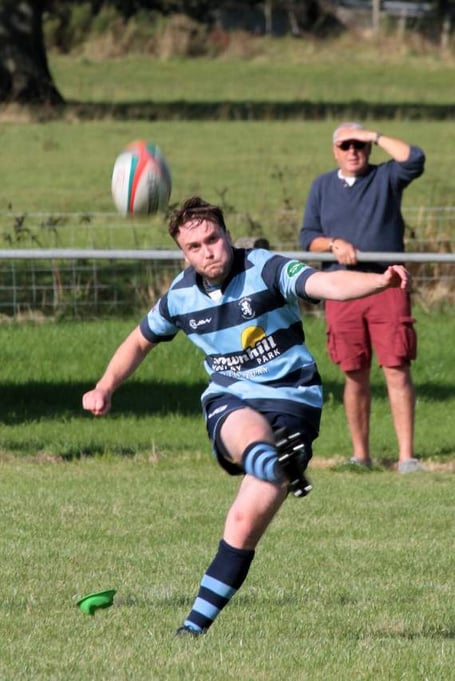
ABERYSTWYTH were involved in a very hard-fought contest between two evenly-matched sides at Yr Hendy, and the final result of 17-10 in favour of the hosts could have gone either way.
In the end, the game was won in a moment of alertness by the home side - and lack of concentration by the visitors.
A quickly taken throw-in by Hendy, after Aber’s full-back Steff Rees had been forced in to touch near his line, enabled his opposite number, Morris, to scamper over to score a decisive, match-winning try, which he successfully converted.
Aberystwyth’s performance was far more disciplined than it had been the previous weekend, and the whole team had to be at their best to contain a well-drilled and much improved Hendy side.
.jpeg?width=209&height=140&crop=209:145,smart&quality=75)


Early pressure saw the hosts force a scrum on Aber’s 22 metre line. The ball was quickly fed out by ex-Aber scrum-half, Gruff Jones, and inside centre Mayze burst through to score a well-taken try, which was then converted by full-back Morris to put the home team 7-0 ahead.
Aber struck back with a Llyr Thomas penalty after Hendy were caught offside at a ruck, before Morris restored the seven point lead with a penalty of his own.
The handling by both sides was well controlled, given the wet ball and the drizzle that fell for most of this encounter. Possession and territory were evenly shared, and both sides varied their attacks in order to create opportunities.
That neither side managed to win the initiative was due to relentless covering and tackling by both backs and forwards.
Lee Gower and Lewis Ellis-Jones worked hard for the visitors in both attack and defence, before the latter was very harshly yellow-carded for a dubious late tackle. Aber’s 14 men held out for the final 10 minutes of the first half to keep the scoreline at 10-3 to the home side.
The second half began in as physical a fashion as the first half had been, but the visiting team more than held their own.
When restored to 15 men, they put pressure on the hosts and made good ground. This Aber pressure eventually told, when Hendy’s No 8 Thomas was sin-binned.
The visitors then forced a series of strong scrummages near the hosts’ line which resulted in a penalty try. With the score now at 10-10 it was anyone’s game.
Neither side could have complained if that had been the closing score, but it was Hendy that seized the opportunity to grab the winning points after a quickly taken throw-in had caught Aber’s forwards napping. The final score at 17-10 did not really reflect how close the encounter had been between these two evenly-matched sides. A losing bonus point was scant reward for Aber’s efforts.
Throughout the match Aber’s forwards scrummaged well, with William Lewis maintaining his good form at loose head prop. In the line outs, Lee Gower and Dan Binks won a lot of ball including some steals on Hendy’s throw-in.
In the loose, the visitors’ back row of Gower, Ellis-Jones and Bryn Shepherd covered well, but Aber were unable to win turnover ball. Strong counter-rucking by Hendy meant that the visitors often won ball under pressure. In general, the hosts’ forwards showed greater physicality in loose play than the Aber eight.
Behind the scrum, Charles Thomas, making his first start at scrum-half, had a good game and his distribution was impressive. But Aberystwyth were unable to gain the penetration in mid-field that was once a strong feature of their game. When they were able to make ground, the moves often fizzled out, either through failure to offload or lack of support.
In defence, however, Aber matched the hosts behind the scrum and Hendy were forced to resort to high kicks in attack.
Steff Rees at full-back had his work cut out in fielding these kicks, but he managed this very well. Meanwhile Hendy’s main attacking strength was on their left wing, where Havard was a constant threat whenever he had the ball.
Division One West is now a very competitive arena and, without a win so far this season, Aber are languishing too near the bottom of the table for comfort.
They have played some good rugby in these opening games, but they still have little to show for their efforts, even though the results so far have been close.
Comments
This article has no comments yet. Be the first to leave a comment.