
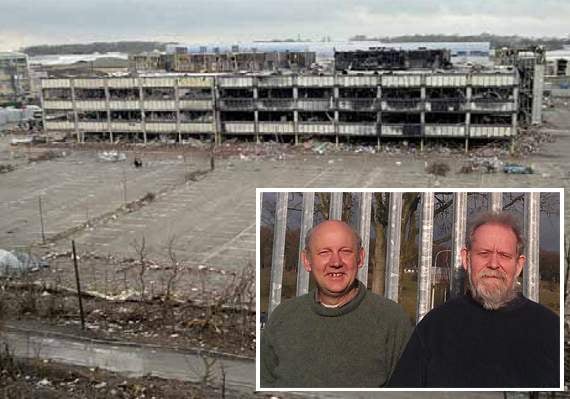
A LAMPETER-BASED physicist has offered a new explanation for the cause of the largest industrial explosion event in the UK for many decades.
The incident – at the Buncefield fuel depot in Hertfordshire on 11 December 2005 – followed the accidental release of a large volume of winter grade car fuel.
Explosion experts Aber Shock and Detonation Research Ltd have now put forward a new explanation by director of theoretical studies, Dr Geraint Thomas, for the extensive mechanical damage to buildings across the huge site.
Drawing on his extensive knowledge gained as director of the former Centre for Explosion Studies at the University of Wales, Aberystwyth, Dr Thomas saw possible similarities between his earlier academic research and evidence presented in the official Buncefield explosion incident investigation reports published by the UK Health and Safety Executive.




Starting in the 1980s, Dr Thomas had worked with many international collaborators on how a specific form of supersonic combustion could develop as pressure waves acted on pockets of burning gases.
This distinct form of combustion, studied at the Physics Department in Aberystwyth since the middle of the last century, is called detonation and is the cause of the well-known phenomena of knock in car engines.
HSE investigators had already identified and discounted two ignition sources at Buncefield, but Dr Thomas has proposed a new alternative explanation that “the Buncefield incident was possibly a multi-stage explosion where separate explosion events, somehow synchronised in time, interact".
He went on to explain: “In this way a credible sequence can be constructed where the pressure wave from a first explosion aggravates a second explosion, at a significant distance from the first and at which location the observed damage cannot be accounted for by the first explosion alone.”
See this week’s south papers for the full story, available in shops and as a digital edition tomorrow
Comments
This article has no comments yet. Be the first to leave a comment.