
Dolgellau Music Club members enjoyed an evening of music from soprano Anusha Merrin and pianist Iwan Owen on Friday, 30 October.
Member Ben Ridler said: “A recital with a large number of separate items can strain concentration, so Anusha and Iwan helped listeners in Coleg Meirion-Dwyfor by creating a sequence 'From Dusk to Dawn' in four sections – Dusk, Nightfall, Sleep and Dreams, and Midnight to Dawn. It was also a good idea to intersperse song sets with short piano solos.
Mozart wrote Abendempfindung (Evening Thoughts) in June 1787, a month after the death of his father, so the image of dusk had a deeper meaning.
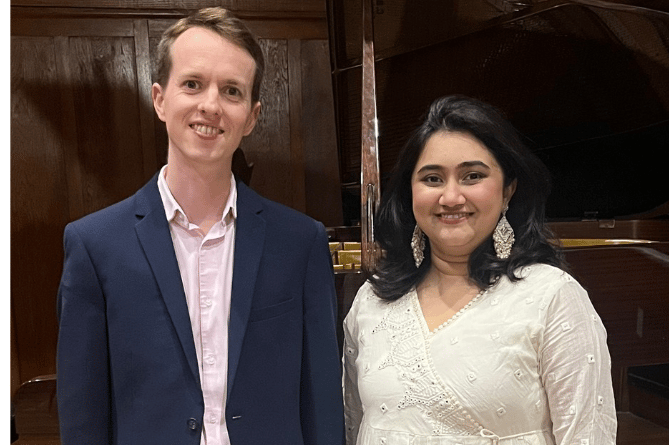
The two musicians drew their audience in straight away, Anusha's beautiful voice in fine balance with Iwan's sensitive accompaniment.
Debussy's Beau Soir advises us 'to savour the gift of life', a phrase that seemed a motto for the evening's experience – a relish carried to the utmost in Reynaldo Hahn's L'Heure Exquise (Exquisite Hour).
Chanson Triste (Song of Sadness) sounds more downbeat, but – written, amazingly, when Duparc was only 20 – its soaring melody brought the first set of songs to an exultant conclusion.
What better than a piano Nocturne to follow, one not by Chopin but by the form's creator the Irishman John Field, his No.2 in C minor. Iwan immediately had his audience spellbound, as in all his solos.
A Brahms Intermezzo was followed by a perfect but less familiar choice, Stars (from Night Pieces) by the Australian composer Peter Sculthorpe; in his detailed programme notes Iwan suggested that the music's climax evokes a meteor shower, a powerful image. The piece was certainly captivating.
Nightfall comprised another youthful song, Debussy's irresistible Nuit d'étoiles (Night of Stars); Fauré's intimate Le Secret; Strauss's persuasive Ständchen (Serenade); and Korngold's no less romantic (but much less well known) Mond, so gehst du wieder auf (Moon, thus you rise once more), begging the moon to 'teach me not to yearn for her'.

(Small wonder Korngold would go on to write some of early Hollywood's most stirring film scores!) That perennial favourite Debussy's Clair de Lune shone brightly as this section came to a close.
English songs by Ivor Gurney, Muriel Herbert and Frank Bridge made a good contrast in the Sleep & Dreams section, as did Amy Beach's Dreaming Op.15 No.3, hypnotic and fully engaging. Comedy lightened the opening to the final Dusk to Dawn section, Wolf's setting of Mörike's Elfenlied (Elf-song) making much of Elf's double meaning in German of both 'elf' and 'eleven', the eponymous elf mistaking the watchman's call of eleven o'clock for a nightingale calling him by name from the valley.
Anusha's crisp diction was at a premium here, as was Iwan's keyboard delicacy. This was to the fore again in Strauss's Wiegenlied (Cradle Song), rippling semiquavers never drowning the voice.
A speciality of Anusha's, Strauss had the last word with two of his greatest songs, Die Nacht (Night) and Morgen (Morning), the composer's wife Pauline (herself a soprano) drawing from him some of the loveliest melodies in the repertoire.
Conventionally, a programme might be expected to open with Morgen; here, it made a wondrous conclusion. Heartfelt applause broke this silence, and a charming Quilter encore; but the sense of rapture lingered long after the concert itself had ended.
Comments
We've recently changed our login process. If you have an account for commenting, you will need to re-register on the login window.
This article has no comments yet. Be the first to leave a comment.