
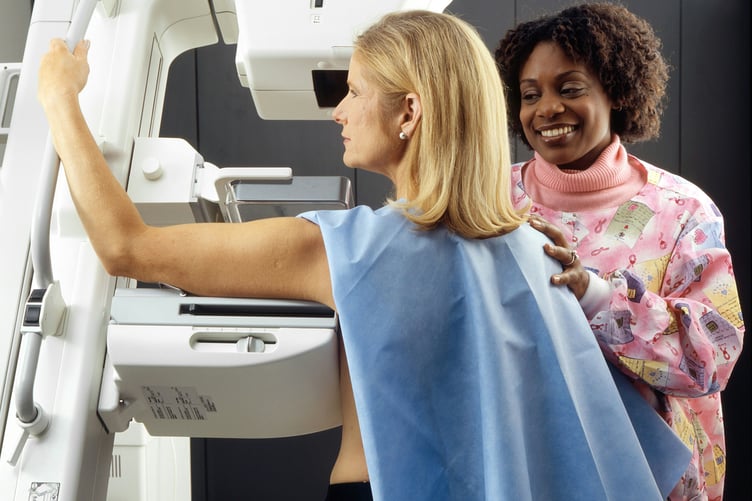
A petition signed by more than 4,000 people has thrust Wales’ breast cancer screening programme into the spotlight amid low take-up and “massive” disparities across the country.
Senedd members considered the 4,254-signature petition on improving the national Breast Test Wales screening programme run by Public Health Wales.
The Senedd’s petitions committee heard only 69 per cent of women invited for screening attended their appointment in 2022/23, below a 70 per cent minimum standard and an 80 per cent target.
The petitioners wrote: “If the 80 per cent target was met, 15,871 more women would have been screened and an estimated 154 more breast cancers detected.”


Breast Cancer Now, which organised the petition, pointed to latest uptake data for the UK – showing England at 70 per cent, Northern Ireland at 74 per cent and Scotland at 75 per cent.
Highlighting an awareness campaign launched in England in 2025, the charity urged the Welsh Government to similarly promote potentially life-saving breast screening.
Plaid Cymru’s Lindsay Whittle was taken aback: “I would say this is certainly the most alarming statistic I have read in possibly the past 35-40 years I’ve been involved in politics.
“To think that 15,000 women are walking around Wales not being screened and 154 of those women probably have early signs of breast cancer is alarming.
“And we have to send out a 999 message to women in all corners of Wales: please use this facility, it is absolutely vital.”
Calling for a communications campaign to save lives, Mr Whittle added: “The low take-up in many areas of Wales is a matter of national concern.”
Vaughan Gething, the former first minister and health secretary, supported calls to ask the Welsh Government for an update on plans for a new wider screening equity strategy.
A Public Health Wales report showed significant disparities, with uptake ranging from more than 70 per cent in Carmarthenshire to 40 per cent on Anglesey in 2021/22.
The committee agreed to write to health secretary Jeremy Miles about the forthcoming screening equity strategy and the use of 11 mobile centres in Wales.
Breast Cancer Now also expressed concerns about delays in data reporting, with a 2023/24 annual report set to be published a year after the equivalent English data.
The charity stressed: “Timely annual statistical reporting, in line with the timescale of other UK nations, increases transparency and accountability within Wales’ breast screening programme, and supports evidence-based decision making and long-term planning.”
In an earlier letter to the committee, Mr Miles told the committee uptake rates can vary across regions, age groups and socioeconomic backgrounds.
He wrote: “The reasons women choose not to take up the offer are complex.
“Factors may include lack of awareness, fear or anxiety about the screening process and results, cultural and language barriers, access issues, and the impact of misinformation.
“We are committed to maximising breast screening uptake across all communities, recognising its vital role in early cancer detection and improved outcomes.”
Comments
We've recently changed our login process. If you have an account for commenting, you will need to re-register on the login window.
This article has no comments yet. Be the first to leave a comment.