
THE EXTENT of the effect that holiday lets and Airbnb properties are having on the ability of lower income residents to find affordable homes to buy and let in mid and north Wales has been laid bare in a new report.
The new report from the Bevan Foundation finds that the growth of the holiday let industry in Wales is having a “dramatic effect on homes for rent as well as homes to buy in many communities in Wales”.
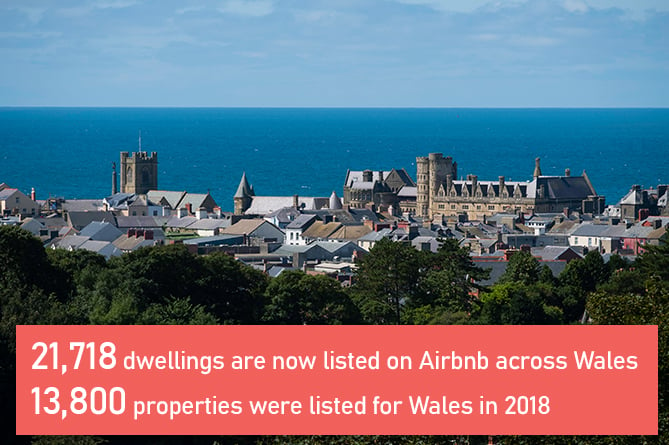
The data reveals that the number of properties listed on one major lettings platform, Airbnb, has increased from 13,800 in 2018 to 21,718 listings in May this year.




More than 3,800 properties in Gwynedd are listed on Airbnb, the data shows – which is the highest in Wales.
In Powys, that number is almost 2,000 – the second highest in Wales.
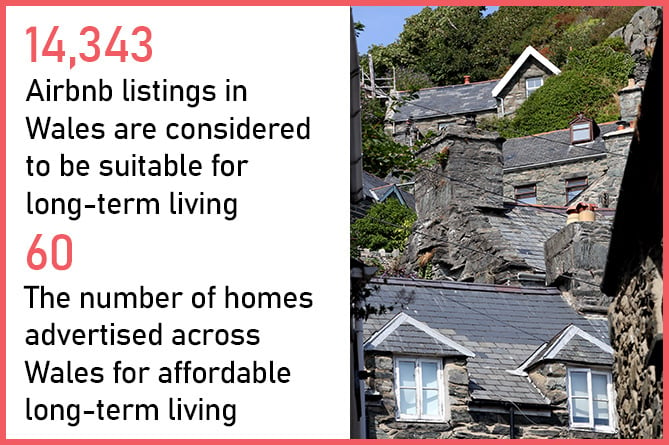
Of the 21,718 listings on Airbnb in Wales, the report finds, 14,343 “appear to be suitable for long-term habitation”.
The proportion is greatest in Gwynedd (4.6 per cent), Pembrokeshire (3.7 per cent) and Ceredigion (3.1 per cent).
Airbnb homes that are suitable for long-term habitation are an even larger proportion of the private rental sector, accounting for 19 per cent of all housing stock in Ceredigion.
The growth in holiday lets comes at the same time as an acute shortage of affordable homes to rent.
Last month the Bevan Foundation found that only 60 properties across the whole of Wales were advertised at rents at or below the amount that a low-income household can receive through Housing Benefit or the housing element of Universal Credit (known as Local Housing Allowance).
Looking deeper into Airbnb lettings reveals just how lucrative the holiday let industry can be.
Steffan Evans of the Bevan Foundation explained: “Property owners can often make significantly greater returns from a holiday rental than from residential lettings.
“On average, it would take a host letting out their property on Airbnb less than 10 weeks to obtain the same annual rental income as a landlord letting their property at LHA rates in all Welsh local authorities except Torfaen.”
The Bevan Foundation recognises the importance of holiday lets to the local economy, but said that with a shortage of affordable homes to rent across Wales, there is a” balance to be struck between the economic opportunities offered by the sector and ensuring people have a home”.
The report outlines that “much of the discussion on the short-term rental sector to date has focused on its impact on people wishing to buy a home in their community”.
“Over recent months, the Bevan Foundation has become aware that there are growing concerns about the impact of the sector on renters as well, particularly those on low incomes,” the report added.
One of the Bevan Foundation’s key findings in its work on homelessness is that there is a gap between Local Housing Authority and market rents.
“Low-income renters are increasingly forced to meet the shortfall from their own funds, while landlords are often reluctant to remain in a market with limited returns,” the report says.
“Even when local authorities or the Welsh Government are able to offer incentives to landlords, attracting landlord interest can often be difficult given landlords can make far more money leasing their property on the open market.
“In some areas the holiday rental market is an additional incentive for landlords to move away from the low-income market or even exit the residential market altogether.
“Very simply, the income that can be generated through letting a property out as holiday accommodation can exceed the market rent in the private rental sector, let alone the LHA rate.
“It is clear that letting a property out via Airbnb is significantly more lucrative for many property owners than letting out a property at LHA rate.”
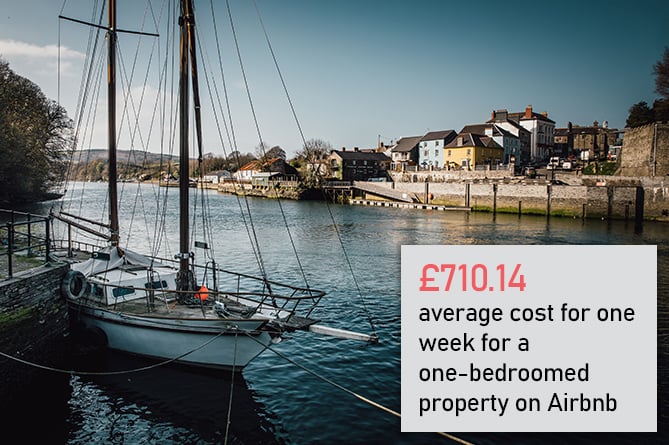
Across Wales, the average price per week for an Airbnb property in May 2022 ranged from £710.14 for a one-bedroom property up to £2,175 per week for properties with four or more bedrooms.
In Ceredigion the average weekly cost of a holiday rental was £574.94, while in Gwynedd and Powys, that number reached more than £715.
Dr Evans added: “With so few homes to rent for low income households, people are faced with an impossible choice: move out of their community, move into poor quality housing, try to plug the gap between their rent and their benefits by cutting back on food and heating, or become homeless.
“If we are to find a long-term solution to Wales’ housing crisis it is vital that work is undertaken to regulate the holiday let sector as well as the private rental sector.”
The report warned that the figures could be even higher as “no official data is available on holiday rentals in Wales”.



The data is based on listings on the most well-known business operating within the sector, Airbnb.
“It is important to note that there are other agencies and platforms that provide holiday rentals so the size of the sector is likely to be even larger than suggested in this report,” the report says.
“We are concerned about the impact of holiday rentals on low-income renters in Wales,” the Bevan Foundation said.
“The report therefore analyses Airbnb listings where the whole property has been advertised as available and where the property appears suitable for long-term habitation.
“Properties such as yurts are not included in our analysis, and nor are spare rooms in occupied properties.”
“The short-term holiday rental sector appears to be a lucrative and a growing sector in Wales.
“Whilst the data analysed in this report only provides a snapshot from one provider within the market, if the 53 per cent growth in number of properties listed on Airbnb in just four years is replicated elsewhere across the holiday rental sector, then it is a sector that is rapidly expanding.
“The data does not allow us to reach definitive conclusions as to whether it is private landlords leaving the residential sector and entering the holiday sector that is fuelling growth.
“What is clear however, is that short-term holiday lets offer significantly greater returns than letting residential properties at the LHA rate. In Airbnb hotspots it appears likely that the sector is having a direct impact on the availability of rental properties for low-income tenants.”
Have your say on the issues that matter to you.
• Email: [email protected] • Phone: 01970 615000 • Join in the conversation on Facebook
Comments
This article has no comments yet. Be the first to leave a comment.