
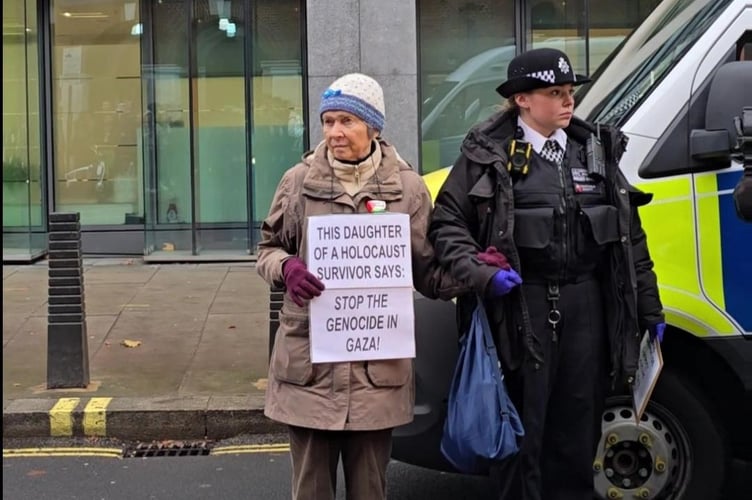
Protestors from west Wales due in court for publicly supporting Palestine Action had their hearings postponed after the High Court ruling.
Many protestors from rural mid and north Wales reached out to the Cambrian News after a judge ruled that the Palestine Action ban was unlawful in early February.
After initially assuming their hearings were still going ahead, which would have caused many to travel to London, their hearings were later postponed.
However, their fate is not yet certain, as on 25 February three High Court judges granted the UK government permission to appeal the ruling.
Eighty-year-old Elizabeth Morley from Aberystwyth was one of over 2,500 people arrested for allegedly publicly supporting the proscribed terrorist group.
The daughter of a Holocaust survivor, who was arrested five times last year for supporting Palestine Action, said: “For the last two years at least, I have been angry and depressed, unable to come to terms with the collapse of morality in our leaders.
“Our country is supposed to be the “good guys”, no longer the “perfidious Albion” of past centuries.
“Yet when it comes to protecting Israel, our government is prepared to be complicit even in a genocide.
“Rather than sanction Israel for committing the most horrific brutality against innocent Palestinians, including children, rather than kick Elbit Systems (the company Palestine Action targeted) off British soil, Keir Starmer continues sending weapons to Israel.”
She was arrested under section 13 of the Terrorism Act, which carries a maximum sentence of six months in prison.


She said if her case is dropped, she will be pursuing compensation for her travel costs.
Following the ruling on 13 February, Ceredigion Preseli MP Ben Lake joined a cross-party group of MPs who wrote to the Home Secretary calling on her to drop the appeal.
The MP representing Ms Morley said: “In the letter, we highlighted how this policy led to thousands of arrests of peaceful protestors – including elderly citizens – placed enormous pressure on courts and police, and risked serious violations of fundamental rights.
“We warned that proscription could become a blunt tool to silence dissent and criminalise legitimate protest.
“The High Court’s verdict was an opportunity for the UK Government to change course and commit to ensuring anti-terror laws are not misused to suppress democratic debate.
“That could have begun to restore trust.
“Sadly, by appealing against the decision, the Home Secretary is showing that the government has learned nothing from this shameful decision."
The proscription put Palestine Action into the same category as the Islamic State.
Following the original High Court ruling, Home Secretary Shabana Mahmood said she was “disappointed by the court’s decision and disagrees with the notion that banning this terrorist organisation is disproportionate”.
Pending the appeal, the Palestine Action ban remains in effect, meaning that publicly showing support for the organisation, proscribed in July, is still a criminal offence.
However, police have indicated that officers are unlikely to continue arrests.
The date for the appeal has not yet been set.
Comments
We've recently changed our login process. If you have an account for commenting, you will need to re-register on the login window.
This article has no comments yet. Be the first to leave a comment.