
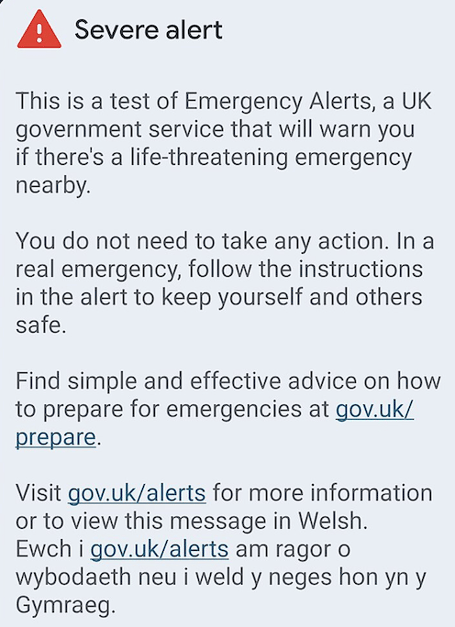
Recently, everyone who has a smartphone – and who hadn’t disabled them – received an emergency alert about the devastating wildfires we saw following an historically dry summer. Essentially, it gave some pretty sensible advice around activities to avoid to reduce the risk of starting a fire.
The alert being sent at all was controversial, but in the circumstances it’s hard for me to argue with it. There clearly is a chunk of the population who either genuinely don’t know that having a disposable barbecue in a forest could cause a fire, or who know full well that it can but are stupid so do it anyway.
The alert was issued at the request of fire services, and there’s no reason to distrust their judgment.
In Wales, however, we had another layer of controversy.
For most people, but not everyone, an alert was issued entirely in Welsh, followed a few minutes later by one entirely in English.
The reaction to this on social media across the political spectrum was bizarre. Right-leaning unionist politicians called for the alert to be sent in English first, or exclusively in English, citing the possibility that an alert that many people wouldn’t be able to read would cause confusion and panic.
Several people also attempted to blame the Welsh Government, despite the very first line of the alert saying that it was ‘issued by the UK Government’.
One person even called for the Welsh language to be “given up on” entirely, though this person was in England so I don’t give any validity to their call.

Some Welsh nationalists were almost gloating that the alert was sent in Welsh first, saying that those who disagree with the way it was done should simply learn Welsh and get over it.



--Right-Victoria-Bond-the-Director-of-CLA-Cymru-(P.png?width=209&height=140&crop=209:145,smart&quality=75)
Neither of these viewpoints are helpful.
In an emergency situation, getting the message out as accessibly as possible to as many people as possible in a timely manner is the most important thing.
Ensuring alerts are provided in Welsh is also important.
These two things don’t have to clash.
My first thought when the alerts came through was “why did this need to be sent twice?”
Previous alerts were always sent bilingually, in one single, shorter message. Not only was this alert needlessly split into two, but It was also quite wordy.
In June, I visited Romania when I received an emergency alert warning of bear activity in the rural village I visited. It was bilingual and short. It simply said the street where the bear was sighted, and instructed people to stay away.
Why couldn’t our alert just be like that, with a link to information on ways to avoid starting fires?
One short, bilingual alert. No one but the most extreme linguistic purists (both English and Welsh) could argue with that.
We haven’t yet had a truly unexpected emergency alert for something imminent and widely life-threatening. All of the tests have been announced ahead of time, the warning for Storm Darragh in December 2024 was announced hours ahead, and so was this one.
When a real emergency comes, we can’t afford to be arguing over language, the order or timings of the alerts or the necessity of one at all.
Going forward, common sense needs to prevail, and we all need to remember why these alerts exist.
Or if you’re that bothered by them, you can just turn them off in your phone’s settings.
Comments
We've recently changed our login process. If you have an account for commenting, you will need to re-register on the login window.
This article has no comments yet. Be the first to leave a comment.