

A DISTURBING report by the UK’s spy leaders warning of a danger of severe food shortages, political destabilisation and possible war, resulting from the collapse of ecosystems, arising from human-induced climate chaos and over-exploitation, remains censored despite demands by MPs for full publication.
In the face of growing concerns over food-security, triggered partly by this summer’s drought and record high temperatures, both the Starmer and Burnham governments are refusing to publish the full report, which was first seen by defence officials more than a year ago.
Westminster’s wan claim is that a 14-page summary available online is sufficient. It isn’t. Everyone has an absolute right to the fullest information over a matter this grave.
The report by the joint intelligence committee and other government departments warns the UK will face catastrophic consequences from the collapse of key ecosystems in other countries, including the Amazon rainforest.
Food shortages, the report found, would be almost certain to result from the decline of ecosystems overseas, as would a big increase in global migration, with the potential to fuel unrest. One of the most worrying findings is that armed conflict, including nuclear war, was a potential consequence, as well as serious food shortages within five years.
It’s understood that publication of the report in full had been planned for last October but was vetoed by Downing Street at the last minute, begging speculation about whether the unredacted analysis is even more sobering than the filleted version on general release.
Wales needs to pay as close attention to such disturbing, but closely argued, scenarios as any other part of the UK. We are actually all in this stewing-pot together.

How, therefore, and to what, if any, extent has the Welsh government engaged with the document titled National security assessment on global ecosystems?
Has it been given access to the complete thing and, if it hasn’t, has it pressed the UK government for full access?


If it has neither seen the full report, nor asked for it, why has it not made such a demand, and will it now do so?
Will it insist that it’s made openly available on the internet?
The response I get is mainly a non-specific spiel. Not a single one of my questions is answered. Nothing I am told suggests this Plaid Cymru government is either familiar with, or understands the urgency of, the content of this highly unsettling report.
Or whether any minister has read even the sparse summary available online, never mind the totality.
It tells me: “This new government is addressing the climate and nature emergency head-on. We have made climate and nature action a Cabinet-level, cross-cutting responsibility across all portfolio areas…” Severe food shortages? Don’t ask. Anyway, we think Tesco is endlessly reliable.
It says what I could never have worked out for myself: “Healthy ecosystems underpin food production, water availability, and economic prosperity.” Try not to yawn.
Adding: “By investing in nature recovery, ecosystem restoration and resilient food systems, Wales can help reduce future risks and strengthen long-term resilience…”
Of course, but such ambition goes nowhere near reflecting the sheer urgency of the security services report, which warns with “high confidence”: “Ecosystem degradation is occurring across all regions. Every critical ecosystem is on a pathway to collapse (irreversible loss of function beyond repair).”
You want to believe that if the Welsh government had read even the truncated version of this report it would have had something to say about it. I have no confidence it has read either. The sleepy tone of its response points to a Friday afternoon fob-off.
It’s a pretty safe bet, too, that ministers really couldn’t care less that the report is being kept hidden from the public. Equally, they won’t be bothered when I say that would make them a willing partner in suppression.
The reality of bluefin tuna returning to our waters
WHAT A strange lot we are, how curiously selective over what in nature we decide is worthy of survival, and what not.
Thus we would be horrified if people started killing Cardigan Bay’s bottlenosed dolphins, but are content to sanction the torture and slaughter of another, equally spectacular, marine giant - the magnificent bluefin tuna.
In the 1960s, this awesome creature - they can travel at 45mph, and grow in length to more than eight feet - disappeared from British waters. Sixty years later, it’s making a faltering, near-miraculous, comeback, partly perhaps because rising sea temperatures from climate disruption may be moving their prey, such as sardines and other small fish, but also because of conservation efforts focused on cracking down on illegal fishing. In his book Rewilding the Sea, an old journalistic colleague, Charles Clover, of the Blue Marine Foundation, calls this effort to restore bluefin populations ‘one of the great conservation achievements of this century’.
A triumph in the midst of a severe biodiversity crisis. How grateful we should be. But no. Instead of celebrating the bluefin’s return, in some minds a single thought reigns: kill it.
Tragically, the UK is exploiting the return of bluefins and undermining this conservation victory by authorising commercial and “recreational” fisheries. In Wales, sanctioning of bluefin killing was initiated, and encouraged, last year by the then Labour government and continues, without pause, under by Rhun ap Iorwerth’s Plaid Cymru administration. It’s a disgrace.
The government here deals with the practice under its so-called Recreational Bluefin Tuna Catch and Release Fishery 2025, which delineates exclusion zones including Grassholm, Carmarthen Bay and specially protected areas of Cardigan Bay. It says all tuna caught elsewhere in Welsh waters must be released “unharmed where possible”.
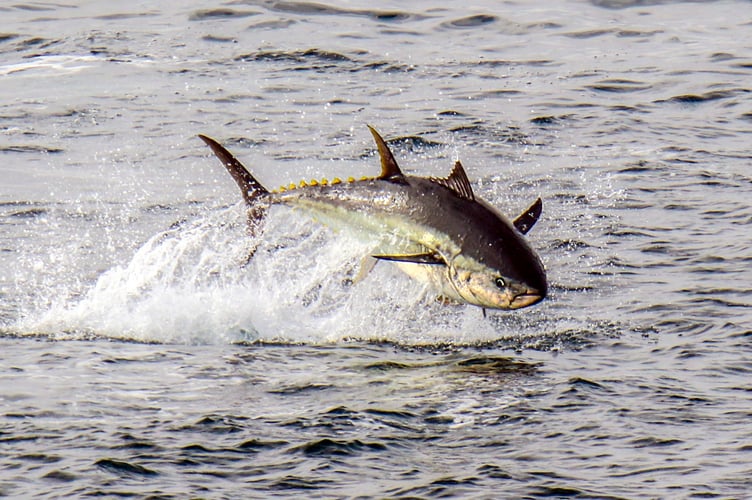
That last is a pious impossibility. And no government can conceivably believe otherwise. No bluefin which has had a hole ripped in its mouth and has struggled, sometimes for hours, to escape a hook, only to be taken out of the sea, handled and thrown back survives unharmed.
The reality, as revealed by official figures, is that hundreds die in British waters yearly as a result of such ordeals.
If you’re a commercial fisherman, of course, you stand to make thousands out of bluefin slaughter. Pose as heroes on the deck of your boat. That’s what’s been happening in recent days in Yorkshire, where fishermen were in paroxysms of excitement after catching two of the fish off Whitby. The crew said they dragged one of the tuna for about five miles before they were able to get it aboard.
Comments
We've recently changed our login process. If you have an account for commenting, you will need to re-register on the login window.
This article has no comments yet. Be the first to leave a comment.