

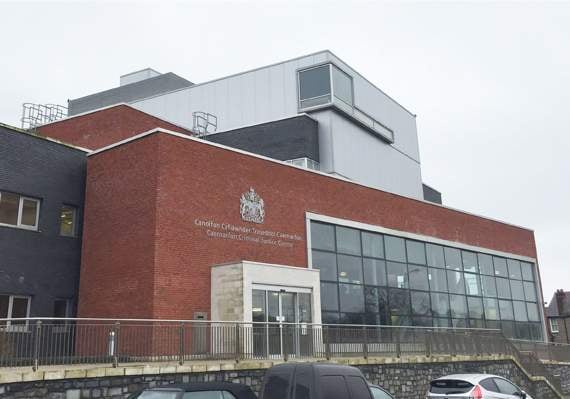
DAVID LAMMY’s determination to dispense with juries in all but the most serious court cases has nothing to do with fine-tuning justice and everything to do with crisis-management brought about by political neglect.
Axe juries, the justice secretary’s one-dimensional argument goes, and courts will be able to rip through the current mighty backlog of cases, meaning speedier resolutions for both victims of crime and defendants.
But this log-jam didn’t happen overnight. It’s the product of inattention to a progressive deterioration in the running of the justice system which a succession of Conservative administrations failed to effectively confront, comparable to the failure over 15 or more years to keep faith with hospital doctors over pay.
On the face of it, scrapping juries may sound irresistible, given the 78,000-plus cases throughout Wales and England waiting for crown court trials, and the likelihood that many new prosecutions will gather dust until 2029 or even 2030.




In Wales, the build-up is sobering. It includes about 750 stalled cases at Swansea crown court, where cases from Ceredigion are sent, and a total of around 560 at Caernarfon and Mold, where defendants from Gwynedd and Meirionnydd are tried. That’s many hundreds of people on both sides of the judicial fence living on tenterhooks, and underlines why the backlog is such a serious issue.
Lammy wants jury trials to be available only to people charged with offences of the utmost gravity - such as murder, robbery or rape. But the status quo, which allows for juries in all normal crown court trials, is being vigorously defended by lawyers alarmed by his blueprint of a single judge alone reaching a verdict and alone passing sentence.
To be against the justice secretary’s sweeping reform does not infer distrust of judges. On the other hand, it’s necessary to say that judges are not infallible, even that they may not always be free of the infection of bias.
But the Lammy plan may not even be in the best interests of judges personally. A retired judge, Chris Kinch, who sat in the court of appeal, says the absence of juries would put judges under a much heavier burden and points to an increase in hostility towards the judiciary. “I worry this could go very badly wrong,” he says. “It’s a privilege to manage juries and run that part of the system, and I am very sorry to see it diminished.”
More basically, take away trial by jury and you inevitably step towards an authoritarian state in which justice is in the hands of the establishment and not the people.
The beauty of juries is that they’re chosen at random, we’re told, from electoral registers. This haphazard singling-out rules out corrupt selection but carries inbuilt risk. Jurors may be diligent, attentive, interested; or bored, or resentful at being plucked out of their daily routines.
Their verdicts may therefore be spot-on, or flawed. But, collectively, their opinions on court evidence stand a good chance of being balanced and sound. They won’t be jaded, as judges may sometimes almost inevitably become, and the novelty of the job may engender a particular clear-sightedness.
Feeling cornered, Lammy brings an alarming casualness to a decision to dismember a system that’s been around for 900 years or so. This is a panic measure. The justice system didn’t get gummed up overnight. The rot set in years ago and should have been spotted and dealt with. Because it wasn’t, victims of crime, and defendants, have been abandoned to years of unnecessary tension and anxiety.
The sickness at Betsi Cadwaladr
THE FAILURES of Betsi Cadwaladr health board are legion and legendary.
Troubles at the crises-riven organisation, which runs 22 hospitals over a vast area of North Wales, including at Bangor, Dolgellau, Pwllheli and Tywyn, has been almost ceaseless since a report in 2013 by Healthcare Inspectorate Wales and the Wales Audit Office concluded that leadership at the board was “fundamentally compromised” because the relationship between the chairman and chief executive had broken down. Both subsequently resigned.
in June 2015, following a mental health services report alleging institutional abuse, the board was placed in so-called special measures, which meant virtually everything it did was closely overseen by the Welsh government.
That sanction ended in 2020, but was reimposed in February 2023 and remains in place as tales of woe over management and patient services drag on. In October, a government report said “fragility, quality and consistency of service delivery continue to be of real concern” in services including vascular, urology, orthodontics, ophthalmology and dermatology.
Eyes are said to be a particular area of concern, with the number of people overdue for clinical follow-up continuing to rise “as does the risk of harm in this group.”
Now a retired consultant has laid into the board for prioritising management consultants over community hospitals, causing increased costs and inefficiencies. Former ear, nose and throat surgeon Jonathan Osborne points out that the cost of engaging business consultants and temporary doctors diminishes spending available for patient care and improvement.
He says: “External doctors are shipped in at weekends to see ‘long waiters’ on outpatient lists. Unfortunately, they lack access to hospital computer systems and cannot order tests, but they can list the patients for surgery, which means the patients need a further review, either to order tests or because the operation listed is either unnecessary or the wrong one entirely. This duplication of resources is expensive, and dangerous.
“We’ve noted a huge agency staffing bill of £72 million in 2022/23 to cover unfilled medical and nursing vacancies. There has been a staggering £2.3million increase in management salaries in 2023-4, and millions spent on white elephant projects.”
These are devastating indictments which, added to the board’s prolonged history of serious shortcomings, should cause the government to question how much longer this vast organisation can be given to get its house in order. It may even be that the sheer size of Betsi Cadwaladr - the biggest health board in Wales, with responsibility for a population of 694,000 - is itself an abiding problem, and that splitting it into two or more entities could provide a fresh start.
Comments
We've recently changed our login process. If you have an account for commenting, you will need to re-register on the login window.
This article has no comments yet. Be the first to leave a comment.