

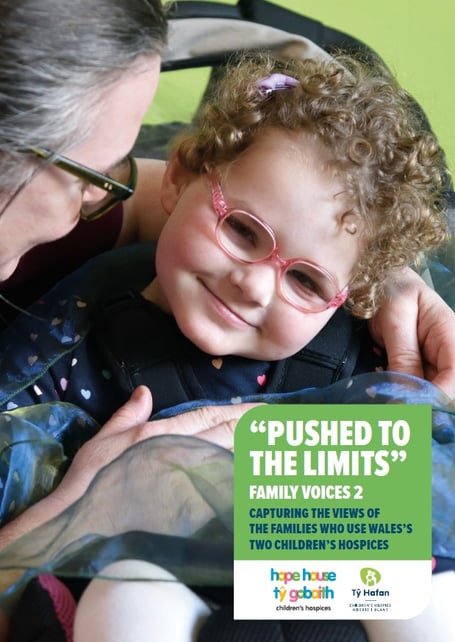
Wales’s two children’s hospices are calling for system-wide change to stop families of children with life-shortening conditions needing to “fight” for help.
During Children’s Hospice Week from 15 to 21 June, Tŷ Gobaith and Tŷ Hafan came together to publish a report which reveals families across Wales are being “pushed to the limits” as they struggle to access the care and support they need.
The Family Voices 2 report reveals families are routinely left navigating a fragmented and complex system of health and social care, and often reaching crisis point before support arrives.
The findings, based on responses from families across Wales, show major gaps between services.



.jpeg?width=209&height=140&crop=209:145,smart&quality=75)
While 76 per cent said hospice care was easy to access, this dropped to 56 per cent for healthcare and just 42 per cent for social care.
At the same time, only 27 per cent said waiting times were never a problem, meaning delays are normal.
Families described finding out about support “by chance”, and said clearer information about services and entitlements would make the biggest difference.
As one parent said: “Not one of my son’s health professionals ever mentioned [the hospice] to us… If I hadn’t self‑referred, we wouldn’t have had the amazing support from the hospice.”
At the heart of the report, families are asking for a system that works.
Families often had to “fight” for support, the report found, with families describing chasing referrals, repeating their story, and making complaints to get equipment, adaptations, or respite.
Among families who found healthcare difficult to access, 86 per cent said the child’s condition not being understood by professionals was a barrier.
“Families reported that the time, money and energy required to overcome barriers had a knock-on effect on work, finances, emotional well-being, education and relationships,” the report found, while travel and cost made access “unfair” with “distance, transport and money affecting whether families could use services, especially for lower-income families and those without adapted transport.”
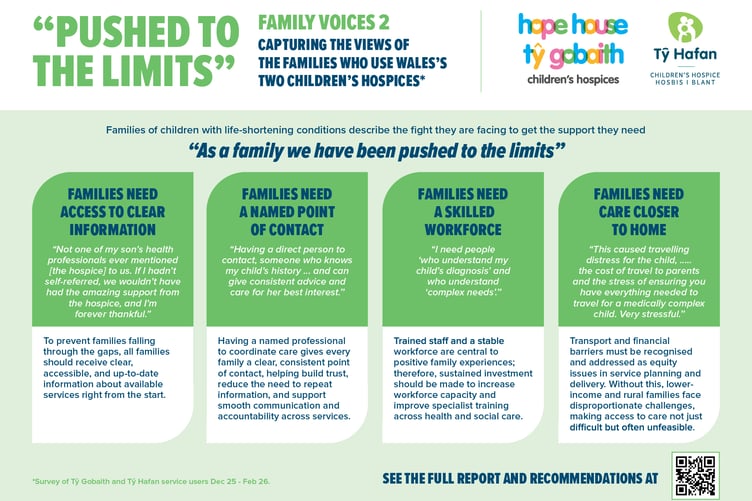
In response, the report sets out eight priorities for change.
It calls for clear, consistent information so families understand what support is available from the start, and for earlier referral to hospice services so help is received before crisis point.
It highlights the urgent need for investment in skilled staff across health and social care who understand complex conditions, alongside giving every family a named professional to coordinate their care.
It also urges action to tackle the real-world barriers families face to access care, including travel, cost and distance, while making services more inclusive and culturally responsive.
Finally, it calls for more consistent end‑of‑life care planning and long‑term bereavement support, so families are not left alone at the most difficult moments.
Sadly, more than a quarter of parents said their child did not die in their preferred place.
Tŷ Gobaith Chief Executive Andy Goldsmith said the findings reflect a system “placing too much responsibility and burden on families”.
“Too many face unnecessary barriers: long waits, confusing processes, gaps in local provision and the exhaustion of having to ‘fight’ for help,” he said.
“Families need a health and social care system that works around them - easier to navigate, consistent and equitable - where parents are not left acting as care coordinator, advocate and crisis manager alongside being a parent, and support comes too late or not at all.”
The report highlights the toll these challenges take on family life.
A third of parents said accessing services severely impacts their ability to work or study, while many reported serious effects on their finances, relationships and emotional wellbeing. For many they talk about being “pushed to the limits.”
The report makes clear that solutions are within reach, but require coordinated action from the Welsh Government, NHS, local authorities and the children’s hospices
Chief Executive of Tŷ Hafan, Irfon Rees said: “We hope people will read this report with the seriousness it deserves and join us in turning what families have told us into real, sustained improvement.
“We are deeply grateful to every parent, carer, child and young person who shared their experience with us for Family Voices 2.
“Sharing takes time and courage, especially when life is already so full.
“Family voices matter, and they must shape what happens next.”
Ty Gobaith is based in north Wales, with Ty Hafan based in south Wales.
Tŷ Hafan provides care for children in the south and west, and Tŷ Gobaith Hope House covers north and mid Wales
The hospices support children across Wales, and in 2026, supported 80 families across Hywel Dda and 10 in Powys.
In 2023, the hospices, with the support of the Welsh Government, commissioned a study by the renowned epidemiologist Dr Lorna Fraser and her team to provide accurate data on the prevalence of children living with life-shortening conditions and the complexity of their health needs.
The data showed a higher-than-predicted growth rate of around 25 per cent between 2010 and 2019, resulting in around 3,655 babies and children in Wales with a life-shortening condition.
A rise of similar proportion is projected in the subsequent ten years to 2029.
The research also found that around a third of children with a life-shortening condition experience clinical instability each year.
“This means approximately 1,200 children each year may require end-of-life care or complex symptom management, both of which demand multidisciplinary, holistic, joined-up care of the kind hospices provide,” the report said.
“The number of children in Wales supported by children’s hospices in Wales was around 450 in 2023, indicating that many children and families were not known to hospice services, where support could meaningfully improve their quality of life.”
As the report was released to coincide with Children’s Hospice Week, Her Royal Highness The Princess of Wales issued a heartfelt message of support – praising the ‘remarkable’ role hospices play in helping children and families make every moment count.
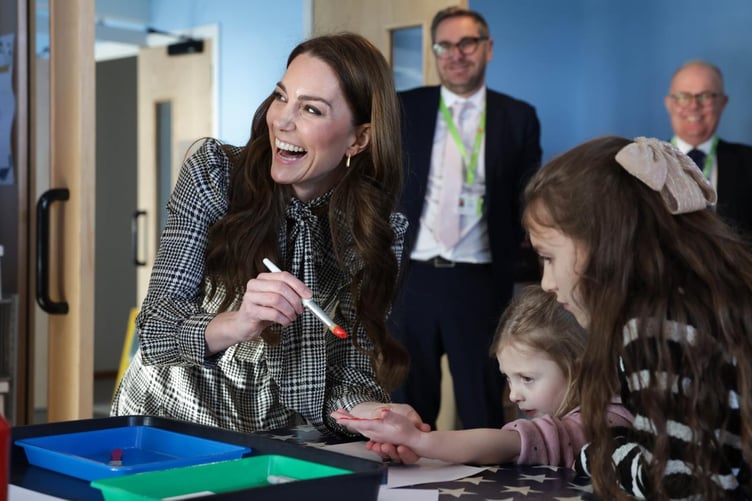
Her Royal Highness is Royal Patron of Tŷ Hafan Children’s Hospice and highlighted how children’s hospices create ‘joyful and nurturing environments’ where children can play, learn and simply be children, while offering families expert care and support throughout their journey.
Led across the UK by Together for Short Lives, the charity for children’s palliative care, Children’s Hospice Week is the only week of the year dedicated to raising awareness of children’s hospice services.
The Princess wrote: “Every childhood deserves to be rich in joy, love, and shared memories.
“As Patron of East Anglia’s Children’s Hospices and Tŷ Hafan Children’s Hospice, I have been privileged to see first-hand how children’s hospices make this possible for babies, children and young people living with serious illness.
“Children’s hospices are joyful and nurturing environments where children can simply be children; to play, explore, express themselves and connect with others.
“For families, hospices offer a compassionate and restorative space to breathe, be together, and find strength in a community that understands their journey.
“This expert, holistic care is delivered by dedicated professionals who walk alongside families at every stage, often over many years, throughout a young person’s life and, when needed, into death and bereavement.
“Children’s hospices are places that protect connection; between children and their families, between families and their communities, between hospice staff and the people they support, and within each child’s own sense of self.
“When we shine a light on the remarkable, yet often unseen, work the hospices do to help children and their families live as fully as possible, we can break down one of the greatest barriers families often face: the fear that reaching out means giving up hope, or that care only begins at the very end.
“Even in the most challenging circumstances, when children are surrounded by attuned care, opportunities for expression, and environments that nurture their whole selves, they can experience joy, belonging and the freedom to be who they are.
“These extraordinary places remind us that even in the face of serious illness, childhood remains a time of creativity, connection and possibility.
“This Children’s Hospice Week, I hope you will join me in celebrating the countless ways children’s hospices make every moment count for the children and families they support, and in recognising the profound, life-changing impact of the culture of care they are working to create.”
Irfon Rees, Chief Executive of Tŷ Hafan Children’s Hospice said: “We are deeply grateful for the ongoing support of our Patron, HRH The Princess of Wales, for Tŷ Hafan and indeed the whole children’s hospice movement.
“In this message Her Royal Highness has shared during Children’s Hospice Week, the Princess talks of the joyful, vibrant and nurturing environments of children’s hospices and also of how they provide dependable, compassionate and restorative spaces for families facing immense challenges.
“By doing so Her Royal Highness is drawing the attention to the profound difference that children’s hospices, including Tŷ Hafan, make to the lives of so many families and reminds us all of the importance of supporting your local children’s hospice so that no family has to live their child’s short life alone.”
The results of the Family Voices 2 report came from three surveys which were run from December 2025 to February 2026 including a parent/carer survey, a bereaved family survey and a children and young people survey.
Families from all seven Welsh Health Board areas responded.
Tŷ Gobaith Chief Executive Andy Goldsmith and Chief Executive of Tŷ Hafan, Irfon Rees said: “This report is built from what families told us about trying to access the health care, social care and hospice support they need when a child has a life-shortening condition.
“Their message is clear: alongside what works well, too many face unnecessary barriers: long waits, confusing processes, gaps in local provision, inconsistent understanding of complex needs, and the exhaustion of having to “fight” for help.
“The impact is significant: it shapes daily life, wellbeing, finances, relationships, education and a child’s experience of childhood.
“Families need a system that works around them: easier to navigate, consistent and equitable; where support is not discovered by chance, and parents are not left acting as care coordinator, advocate and crisis manager alongside being a parent.
“Distance, transport and cost are equity issues, and the greatest burdens fall on families already facing the biggest practical obstacles.
“Bereaved families also shared their experiences of support after a child dies.
“Compassionate, timely care can help families endure, yet too often it depends on families having the energy to ask, transitions feel abrupt, and practical and financial “cliff edges” appear after a child dies.
“We must do better, together, so no family is left isolated when care most needs to wrap around them.
“We are deeply grateful to every parent, carer, child and young person who contributed.
“Sharing these experiences takes time and courage, especially when life is already so full. Your voices matter, and they must shape what happens next.
“As hospice charities, we will keep evolving our services and strengthening how we work alongside the NHS, local authorities and partners to make care more accessible, joined up and family centred.
“But meaningful change also needs collective action: shared standards, sustainable funding, a skilled workforce, and a commitment across Wales that families will not have to reach crisis point before the system responds.”
Ty Gobaith supports more than 750 families who are either caring for a terminally ill child, or whose child has died.
It costs £10 million every year to run the hospice’s services.
Approximately two month’s income comes from statutory sources and for the other 10 months of the year we are dependent on public support.
Tŷ Hafan supports around 300 children with life-shortening conditions and around 3,000 family members each year and says that it can only currently able to help one in 10 families who need it.
Only 16 per cent of Tŷ Hafan's care costs were funded by recurring statutory funding, with the total cost of care expected to be £8.4m in 2026/27.
For information on the two hospices and to donate to help, visit the Ty Hafan and Ty Gobaith websites.
Comments
This article has no comments yet. Be the first to leave a comment.